
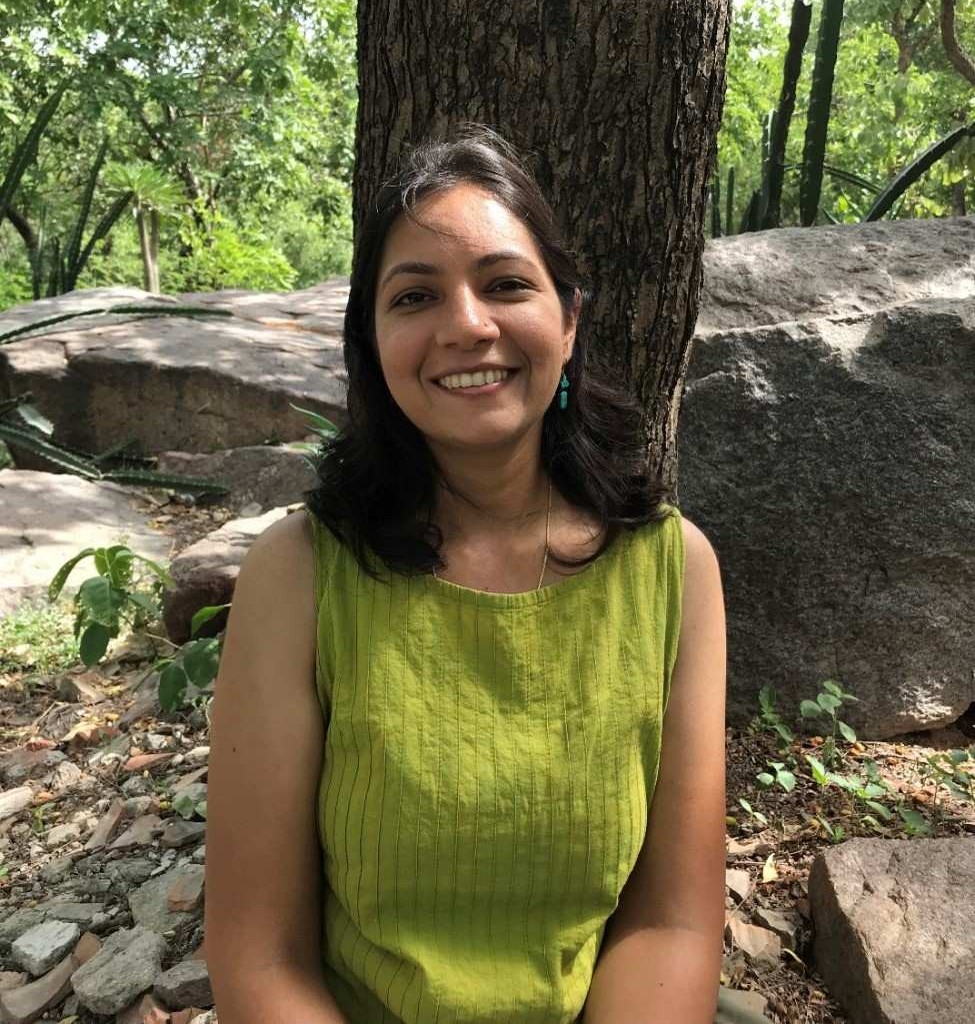
I have seen many interesting bird behaviours in Delhi that I had never thought possible in such a densely populated city. During my first field season (while conducting research for my PhD), I observed a Black-rumped Flameback feeding on ripe figs of a banyan tree from a friend’s terrace. I was so excited to see that – not only are woodpeckers hard to sight in residential areas, but to see one feeding on a fig! I thought I had discovered some novel behaviour, until I went back and read that it is well-documented. A couple of years later, while observing a massive blooming semal tree (Bombax ceiba) with a friend near a heritage site in Delhi, we saw the courtship display of the Indian Grey Hornbill, with the male plucking a tender flower ovary and feeding it to the female. My friend managed to record the entire sequence on camera while I was still struggling with mine!
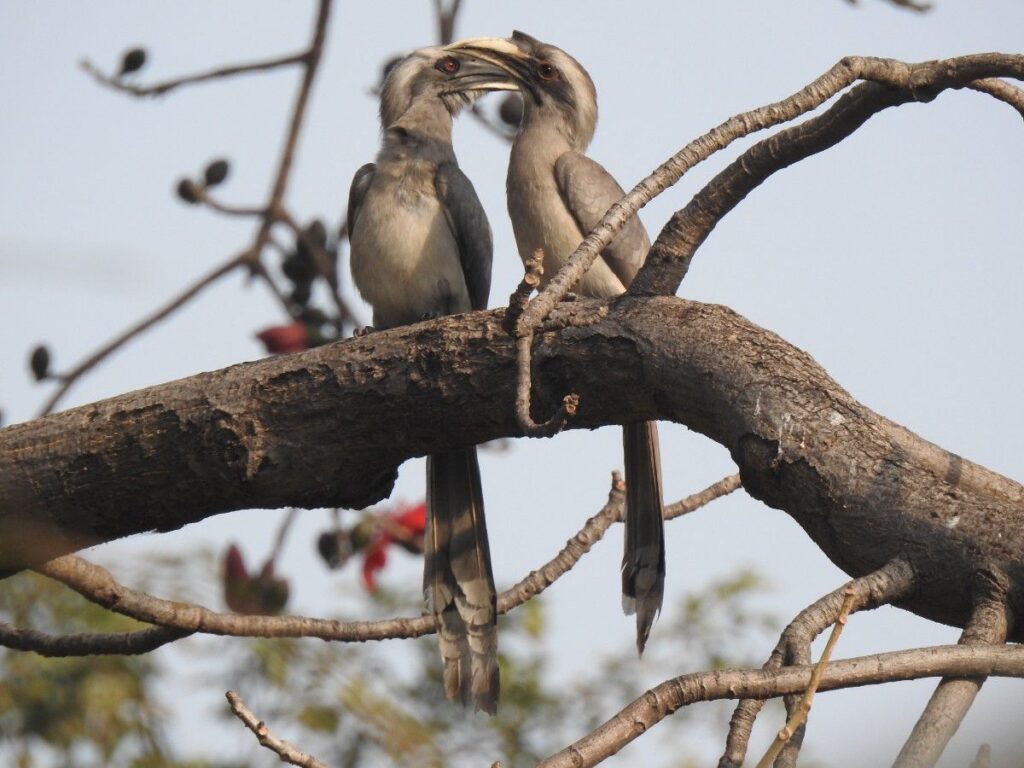
A pair of courting Indian Grey Hornbills in a grove of semal trees in Delhi. (Photo Credit: Vallari Sheel)
Since then, I have seen the courtship of hornbills several times, and most often on semal trees. It increased my admiration for this magnificent tree even more. Over the years, I also saw both the Black and Ashy Drongos not only nectaring on the semal, but also catching bees that come to the flowers. It’s a double feast for them!
Another time, I found a massive Jadi tree (Ficus amplissima) in a park in a very public location. It was fruiting and bursting with birds. I counted eight Brown-headed Barbets, including juveniles, at least three pairs of Grey Hornbills, and several Coppersmith Barbets, Common Mynas, bulbuls, babblers, squirrels, parakeets and more, all feeding on the tree simultaneously. The adult barbets were constantly flying in and out of the tree, carrying ripe figs in their beaks, presumably to feed their young which must have been in nests nearby. To see such a huge mixed-species feeding flock was amazing – it was literally a feast for them! I went back to that tree multiple times over the next few days just to partake in this wonder.
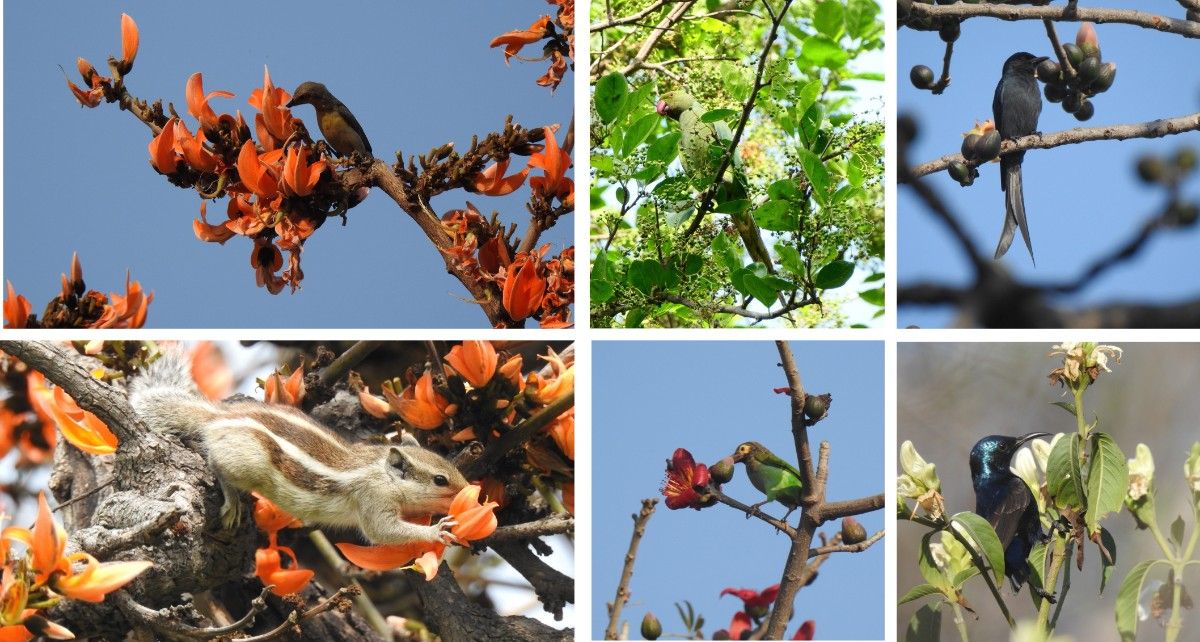 Photos from my fieldwork in Delhi. Left to right: A Purple Sunbird female nectaring on Palash (Butea monosperma), A Rose-ringed Parakeet feeding on unripe Chamrod (Ehretia laevis) fruits, An Ashy Drongo on Semal, A Five-striped Palm Squirrel foraging on Palash flowers, A Brown-headed Barbet nectaring on Semal, A Purple Sunbird male on Adusa (Photo Credits: Vallari Sheel)
I could go on and on with more such experiences. What’s interesting is that this is all happening right in our backyards, in the middle of the city, but hardly anyone notices. I did not have to travel outside the city or to a jungle to witness these magnificent events. This has strengthened my resolve to advocate for urban trees and share their significance with the public. I have also seen some less documented behaviours that I plan to write about soon.
This is how my interest in birds and nature took shape…
I have been fortunate to grow up in a very green neighborhood in Delhi. My innate attraction to nature was nurtured by my mother in various ways. As a toddler, she would take me around the neighborhood in a stroller and point out the names of all the trees, birds, and flowers she knew. I often drew nature scenes in my artwork. I also trained in Indian classical dance and music, and my favorite pieces were those related to and describing nature in various forms. In middle school, I became hooked to Discovery and National Geographic channels, as well as David Attenborough (this was all before the internet era!). I also participated in various environmental activities at school through educational programs conducted by TERI (The Energy and Resources Institute, Delhi).
My first experience with birding was at home. I discovered a dusty copy of Salim Ali’s The Book of Indian Birds in a pile of books in the garage when I was 16. Fascinated, I started carrying it everywhere and flipping through the pages. That’s when I realized that the bird I had been thinking of as a hummingbird was actually a sunbird, though it took me a while to identify the correct species. A few days later, I saw a Rufous Treepie perched on an electric wire right outside the house. I was so excited that I ran inside to get my mother and show her the bird. I couldn’t believe such a large bird existed and that I had never noticed it before! From then on, I became more aware of the birds around me and started identifying them, which helped me notice them even more.
By middle school, I knew I wanted to pursue a career in environmental or wildlife research but wasn’t sure how to go about it, so I took one step at a time. I studied science in high school, after which I pursued BSc (Hons) Biological Science from Sri Venkateswara College, University of Delhi, followed by a Master’s degree in Environmental Studies from TERI University in Delhi. Pradip Krishen’s Trees of Delhi was published while I was pursuing my Bachelor’s degree, and like Salim Ali’s book, it helped me connect with the trees around me. They were no longer nameless entities!
A few years after completing my Master’s degree, I met Padmawati Dwivedi who had conducted the first citizen-led tree census in her neighborhood in Delhi. Inspired by her, I undertook a similar project in my own neighborhood. It was a huge undertaking, and I wasn’t sure if I would be able to complete it when I started, but with the support of friends, family, and the community, I managed to finish it. During this time, I began joining Pradip Krishen and others for nature walks, familiarizing myself with the city’s diverse environments. Simultaneously, I provided research for Public Interest Litigations in the National Green Tribunal (NGT) on various matters related to urban environments and urban trees. All these experiences made me realize the significant knowledge gap in urban ecology in Indian cities. I was also working at an anti-wildlife trafficking consultancy (Freeland India), but I wanted to focus more on urban ecology research. I was fortunate that within a couple of years, I had the opportunity to pursue my interests through a PhD program in Fisheries, Wildlife and Conservation Biology at North Carolina State University, USA, under the guidance of Dr Madhusudan Katti.
Currently, I work on many different fronts. Primarily, I am an urban ecologist studying the interactions between wildlife, vegetation, citizens, and their environments in urban areas. As part of my PhD research, I am examining interactions between birds and urban trees. Specifically, this research aims to identify important food resource tree species (in the form of nectar and fruit) for birds and other diurnal urban vertebrates in the cities of Delhi and Bengaluru. I am also investigating citizens’ perceptions of urban trees in both cities. Additionally, I am a nature educator and engage in public science communication to highlight the significance and beauty of urban nature and ecosystems through my nature walks (for both children and adults) and social media accounts. I work with communities and municipalities to improve urban habitats and campaign for the protection and preservation of urban ecosystems, especially old, mature trees, which are rapidly disappearing in many cities across the country. Furthermore, I am a strong proponent of native flora and advocate for including native species in our urban plantation programs. Over the last two years, I have started learning about ecological restoration and am a member of a vibrant community of practitioners – the Ecological Restoration Alliance of India, with the aim of applying these principles in urban spaces. I am also establishing a native plant nursery with a couple of friends in Delhi, where people will be able to get native plants of this region, as these are usually not available at regular commercial nurseries.
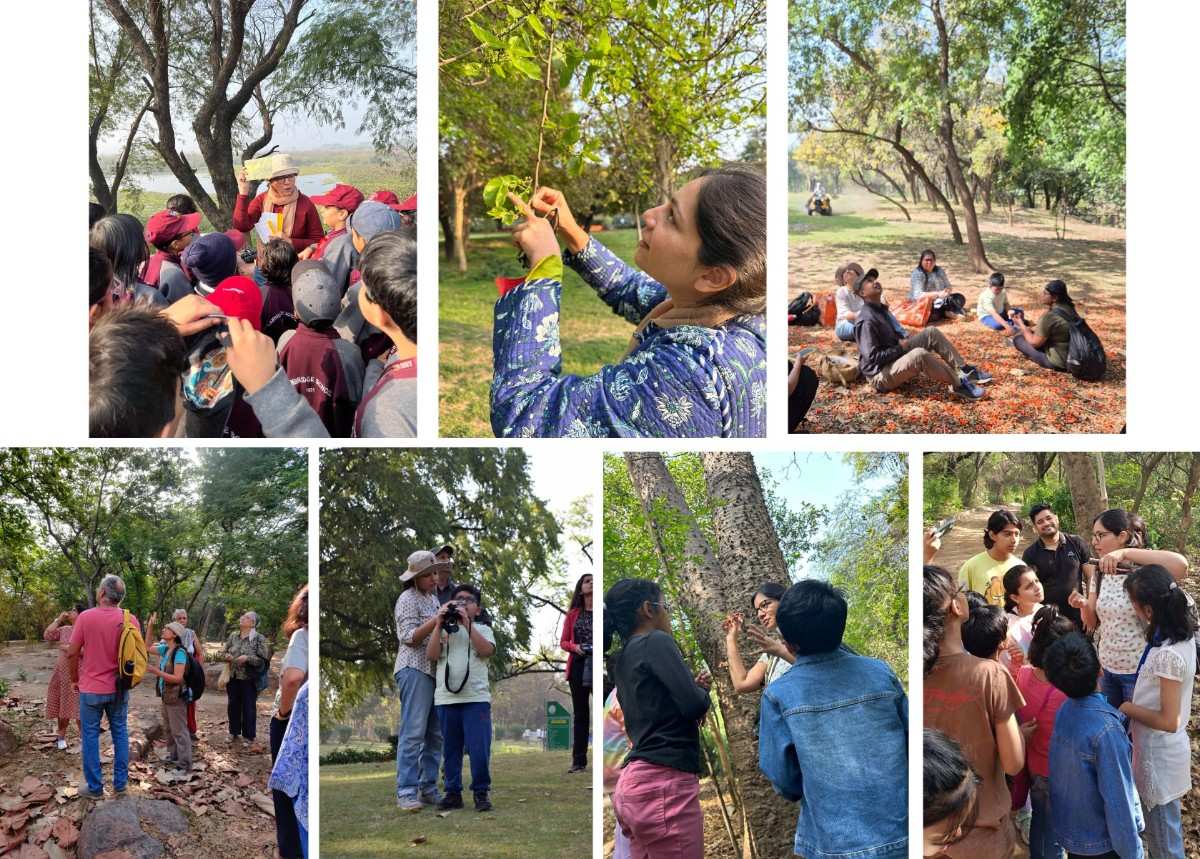 Engaging with children and citizens in my nature appreciation walks
I love what I do because..
I really love heading out and exploring different green spaces in the city—something I probably wouldn’t have done if I weren’t a researcher. I have discovered trees and plants hidden in corners and sometimes in plain sight that often go unnoticed. I have observed many different and interesting bird behaviours, which again wouldn’t have been possible if I weren’t spending so much time outdoors. I love watching birds, and I especially enjoy spending time in nature, away from the stress of everyday life. It keeps me grounded and is a great stress buster. During COVID, I spent a lot of time in my garden observing all the birds and butterflies visiting it, and it kept me sane! I also like sharing my knowledge and learnings with others, especially a wider public audience. I often emphasize the connection between mental health and the presence of birds, trees, and greenery in the city during my nature education walks and activities. Seeing people make that connection and start to appreciate urban nature brings me great joy. I also work with several interns, and I enjoy interacting with them and developing skill sets together.
Challenges I have faced…
Living and working in Delhi is a mixed bag! The city is notorious and often criticized for its high air pollution and safety concerns. However, it also boasts of numerous parks, green spaces, and heritage sites, many of which are freely accessible to the public. Having said this, working in Delhi does present its own challenges. Once, while driving to a field site, someone attempted to snatch my chain just 100 m from a police check post. Fortunately, the person gave up, and I was unharmed. The police promised to increase patrols in that area. On another occasion, my intern’s bag was stolen from a park, and despite the police being notified, their response was ineffective and unhelpful.
Most of all, I have had major issues with men approaching me in various parks, asking all sorts of personal questions—who I am, what I do, my father’s occupation, where I live, etc. I have often wondered why they feel entitled to ask me these questions – is it because I carry a camera and binoculars in a public space? After the first few incidents, I became wary of people approaching me and preferred not to engage in conversations. I have also been harassed by security personnel and household employees while doing fieldwork in my own neighborhood, and I ended up calling the police both times. Although they were helpful, no concrete action was taken against anyone.
All these incidents occurred in public spaces and represent challenges that most women face in the city. Harassment is closely linked with gender in Delhi. That’s why I am very cautious with my interns, many of whom are young women conducting fieldwork in various parts of the city. I usually have them work in pairs, only in safe public spaces, and instruct them to leave immediately if they feel even slightly uncomfortable due to someone nearby.
Another challenge has been being prevented from carrying a camera or taking photographs of flora and fauna in public spaces. I’ve lost count of how many times security guards in parks or on roads have stopped me and ordered me not to take photos, even when no such rule exists. It constantly frustrates me that I must explain each time that I am not engaged in commercial photography but simply taking pictures of trees and birds to share with others. Even after explaining, I may or may not be allowed to use my camera. On several occasions, this conversation has escalated into heated arguments. Over time, I learned that the guards have no authority to stop me, so I explain my purpose and continue my work despite their protests. However, I often have to leave the area to avoid further confrontations, which affects my mood, work, and research.
In Bengaluru too, my team also could not take cameras into Cubbon Park and Lal Bagh, two of our major field sites. As a result, we have very few photos from Bangalore to share with the wider public. Additionally, access to many public parks in the city is restricted, as they close during the daytime from 10 AM to 4 PM. I don’t understand why these restrictions exist in our public spaces – they are meant to be easily accessible to the public, not inaccessible!
I also find multitasking challenging, and my social media science communication has taken a backseat for some time. However, I am aiming to dedicate more time to it, as I have many interesting facts and stories to share from my fieldwork and observations of urban nature around the city.
My advice to young researchers is…
To be successful and happy in this field, one should definitely be passionate about this work and continue to upskill themselves. Many resources are now available online, such as Early Bird’s The Wonder of Birds course, NPTEL’s Basic Course in Ornithology, courses from the Cornell Lab of Ornithology, and numerous webinars on YouTube. Universities and research groups also offer a variety of workshops and field courses, many of which are open to a wide range of participants. Aspiring researchers should take advantage of these valuable resources to educate themselves. They should also pursue different kinds of internships to determine whether a long-term research career is suitable for them. Internships will help them understand the various aspects of research (as not all of it involves exciting fieldwork; a significant portion may involve sitting at a computer and managing data) and the rigours of the process. The YETI mailing list (Young Ecologists Talk and Interact) is one of the best resources to get information about all of these at a national level, while the Ecological Society of America’s ECOLOG-L listserv is one of the best for international opportunities. Another way is to start exploring nature around them, wherever they live. Many cities have vibrant birding and naturalist groups, regularly organising nature walks. There are many birding events, festivals and citizen science programs to help collect data on birds and understand them better, all of which can be found on the Bird Count India website. Taking part in these will also help young researchers connect with others, including seasoned researchers, and gain insights from their experiences.
Ornithological research may not be a high-paying field, so one should be aware of this when making a career choice. Although it is somewhat unconventional, it can still be highly competitive due to limited job and research opportunities, and funding situations can vary with different governments. It is important to continue developing transferable skills, such as research methodology, data collection and analysis, report writing, advocacy, and communication strategies, as one never knows what opportunities may arise in the future. One should not feel discouraged even if one is unable to enter mainstream research through the traditional route. Many new opportunities are now available; for example, wildlife and environmental organizations often look for skilled communicators and social media specialists, including those with videography and design expertise. Interested youngsters possessing these kinds of skills can get involved through such alternate routes. Finally, I would like to ask all the budding researchers to continue to engage with their family, friends and community and educate them about the significance of nature and natural ecosystems. Ultimately, helping the wider citizenry build that connection with nature is the most important thing. And don’t forget to continue birding, whether in the city or elsewhere, and keep enjoying and appreciating nature!
Vallari Sheel
[email protected]
PhD Candidate
Department of Forestry and Environmental Resources,
North Carolina State University, Raleigh, USA
Personal Website
Project Website
Professional Instagram
LinkedIn
YouTube channel
Wonderful Vallari! Challenges are there in life, carry on……..
Well documented work Vallari. I liked the part where the challenges have been narrated. Also the advice to the youngsters.
Thank you, uncle. Please do share with any youngsters who may be interested in an ornithology career.
So interesting to read this . I agree with you completely on the importance of green spaces in the city and how much bird and animal life it supports.
The link between green spaces and mental health is also very valid.
There’s a line which sums it up “ when you feel blue – go green”
I will look forward to joining you in your birding/nature walks whenever possible
Would be lovely to have you! Please email me and I can send you a link to the WhatsApp group where I post about my walks.
I have noticed crows sipping nectar from Semal flowers!
Yes, they do. Semal is an extraordinary tree, and one of my favourites! I have counted 15+ bird species in Delhi which feed on the nectar of semal flowers, another 6 feeding on insects and pollinators, and several which nest and roost in it.