
A recent experience at Keoladeo National Park in Bharatpur particularly stands out to me. I had only a single day in the park, and to make the most of it, I spent nearly nine hours birding and walked over 15 kilometres. The morning was cold and thick with fog; visibility was poor, but the landscape felt almost magical, with mist hanging over the wetlands and trees. While birding was initially challenging, the atmosphere itself was deeply rewarding. As the day progressed, the fog lifted, light improved, and the park came alive. By the end of the day, it had become one of my most memorable birding experiences.
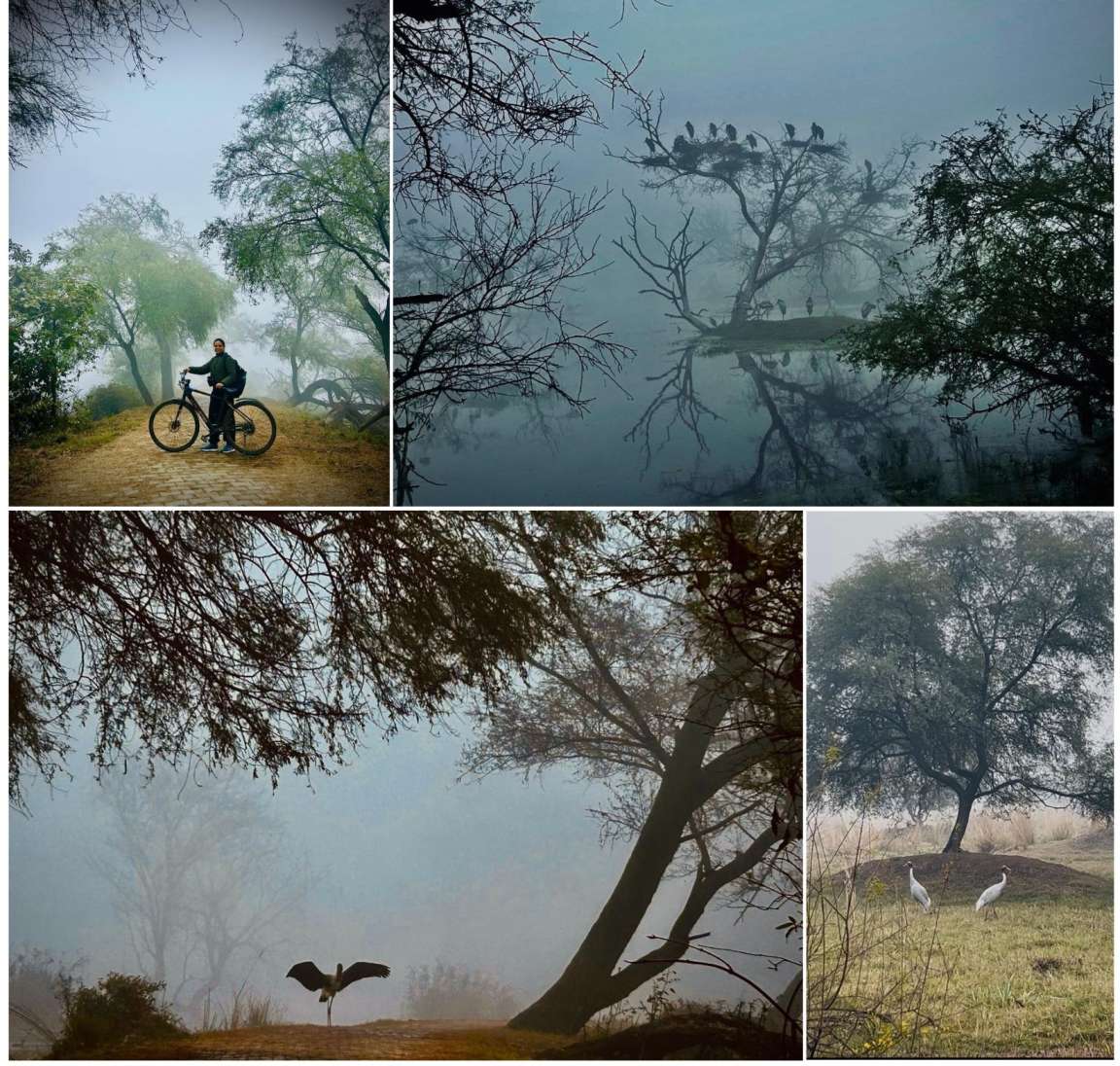 Photos from my visit to Keoladeo National Park, Bharatpur: Clockwise from top left: Me birding in the national park; Juveniles of the Painted Stork; a pair of Sarus Cranes, and a Painted Stork.© Garima Gupta
This is how my love for birds and nature took shape…
Growing up in Dehradun, surrounded by the rich biodiversity of the Himalayan foothills, I was constantly drawn to natural landscapes and the diversity of life they sustain. This early exposure led me to pursue a Master’s degree in Environmental Science at Doon University, where I began engaging more critically with environmental challenges and conservation issues. It was during this period that my interest in biodiversity conservation deepened.
During my master’s degree, I engaged directly with communities through two formative projects. The first was an internship at Rajaji National Park, where I worked on issues surrounding the rehabilitation of the Van Gujjars. The second was my thesis on human–wildlife conflict. These experiences exposed me to the realities of conservation on the ground—where ecological objectives intersect with livelihoods, rights, and justice. They profoundly shaped my commitment to community participation and equity in conservation science.
My interest in birds developed somewhat later in my academic journey during my PhD at the School of Natural and Environmental Sciences, Newcastle University (UK), where I worked on Galliformes—pheasants, partridges, and quails—in the Greater Himalaya under the supervision of Prof. Philip McGowan. My thesis, “Data and Conservation of Himalayan Galliformes,” focused on the role of historical data in conservation science and decision-making. During this time, I also applied and tested the then newly proposed IUCN Green Status of Species framework across 12 Himalayan Galliformes species, contributing to early methodological insights into species recovery assessment.
Working with biodiversity-rich yet data-poor regions such as the Himalaya revealed how conservation decisions are often shaped—and constrained—by the types of knowledge that are available and prioritised. This prompted me to reflect more critically on whose knowledge counts in conservation, how governance systems incorporate (or overlook) local values, and how these choices influence policy, management outcomes, and trade-offs affecting communities.
Although my doctoral research was largely desk-based and grounded in historical datasets rather than fieldwork, it immersed me deeply in avian ecology and conservation questions. As a PhD student, I had the opportunity to join a field course on bird identification alongside undergraduate students—an experience that marked my entry into birding. Learning to identify birds in the field brought the science I had been engaging with on paper vividly to life.
Teachings from my PhD shaped my postdoctoral direction. In 2022, I joined The Beacon Project at the University of Stirling under the supervision of Dr. Isabel Jones, where I examined trade-offs between United Nations Sustainable Development Goals using hydropower dams as a model system. Hydropower contributes to clean energy and climate mitigation targets, yet often does so at the expense of biodiversity and local communities. I led case studies in Tehri and Arunachal Pradesh, analysing how infrastructure development reshapes socio-ecological systems and governance dynamics. Through this work, I moved beyond species-level conservation toward understanding conservation within broader development, justice, and institutional frameworks.
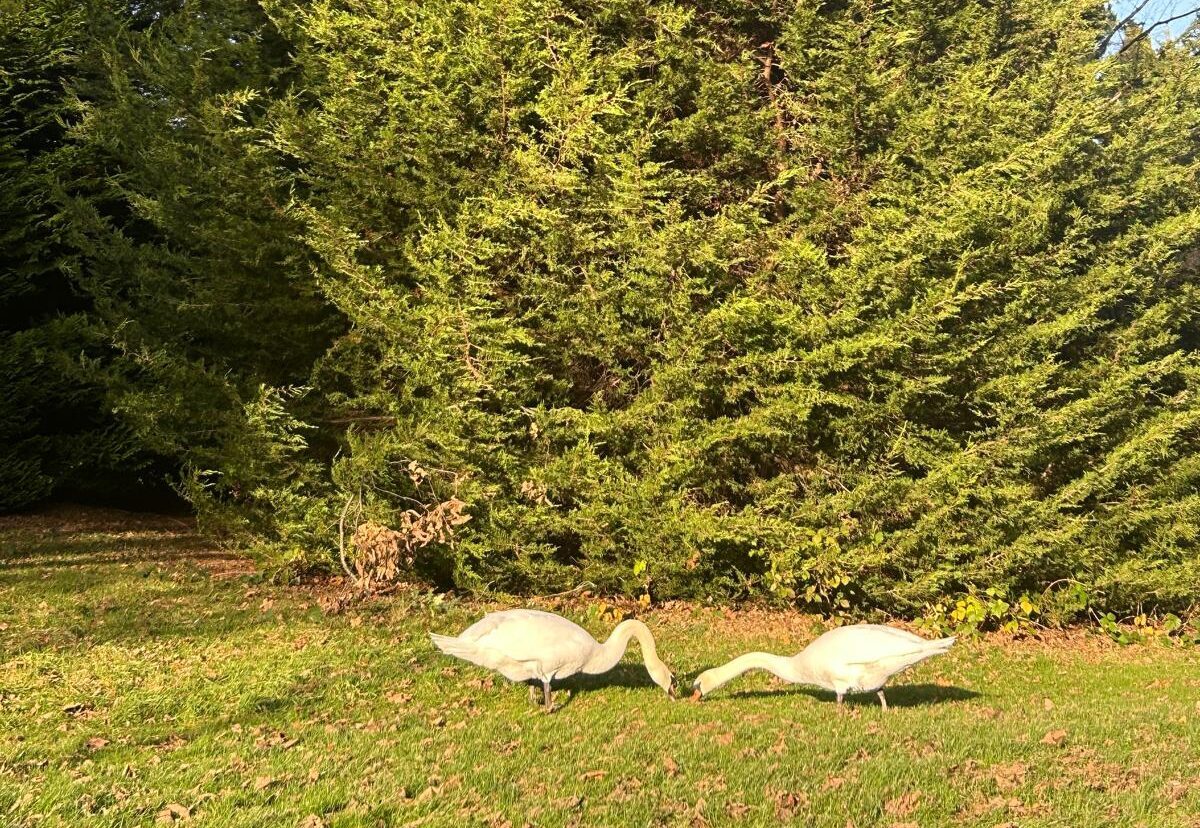 A pair of Mute Swan in the University of Stirling, Scotland © Garima Gupta
Since my PhD, I have increasingly worked at the science–policy interface, which has deepened my interest in how scientific knowledge can be translated into evidence-based policy and actionable conservation strategies. Over time, my work expanded to global environmental assessment and target-setting processes—such as those under the Convention on Biological Diversity (CBD), the Intergovernmental Science-Policy Platform on Biodiversity and Ecosystem Services (IPBES), the Intergovernmental Panel on Climate Change (IPCC), and the Kunming–Montreal Global Biodiversity Framework—and how these global commitments translate into national policies and local conservation actions.
Together, these experiences have shaped my research trajectory towards examining biodiversity conservation within complex socio-ecological systems, with a focus on aligning ecological evidence, social justice, and policy relevance in the Global South.
I currently work as an independent researcher, developing research that focuses on co-developing nature-based approaches to biodiversity conservation and climate change with Indigenous communities and local people in the Greater Himalaya. A central aim of my work is to understand how traditional knowledge systems, lived experiences, and local stewardship practices can meaningfully inform conservation strategies, particularly in the context of global biodiversity and climate targets. I am especially interested in highlighting the importance of plural ontologies—recognising that different ways of knowing and relating to nature are essential for designing conservation approaches that are both environmentally sustainable and socially just. From this perspective, I argue that global targets cannot be achieved without the meaningful involvement of Indigenous Peoples and Local Communities (IPLCs).
Alongside this, I remain actively engaged in species-focused conservation work through the IUCN. Since my doctoral research, I have been involved in assessments under the IUCN Green Status of Species framework for Galliformes. This engagement led to my membership in the IUCN Galliformes Specialist Group under the Species Survival Commission. To date, I have contributed to and published twelve Green Status assessments. The IUCN Green Status of Species evaluates species recovery across their indigenous range and assesses the impact of past and ongoing conservation actions on their recovery trajectories, providing a complementary perspective to extinction risk assessments.
I love what I do because…
What I enjoy most about my work is the breadth of engagement it allows—from generating research questions and producing evidence, to contributing meaningfully to conservation practices and broader discussions around policy and justice. I find deep satisfaction in knowing that my research can inform real-world conservation efforts, whether by shaping how biodiversity targets are interpreted, or by highlighting whose knowledge and voices are included in those processes.
Equally important to me is the opportunity to step outside academic spaces and spend time in nature. Being in diverse landscapes, observing wildlife, and engaging with indigenous people and local communities who coexist closely with biodiversity continually grounds my work. These experiences offer perspectives that cannot be captured through datasets alone and reinforce the importance of understanding how people relate to, care for, and depend on nature in different ways.
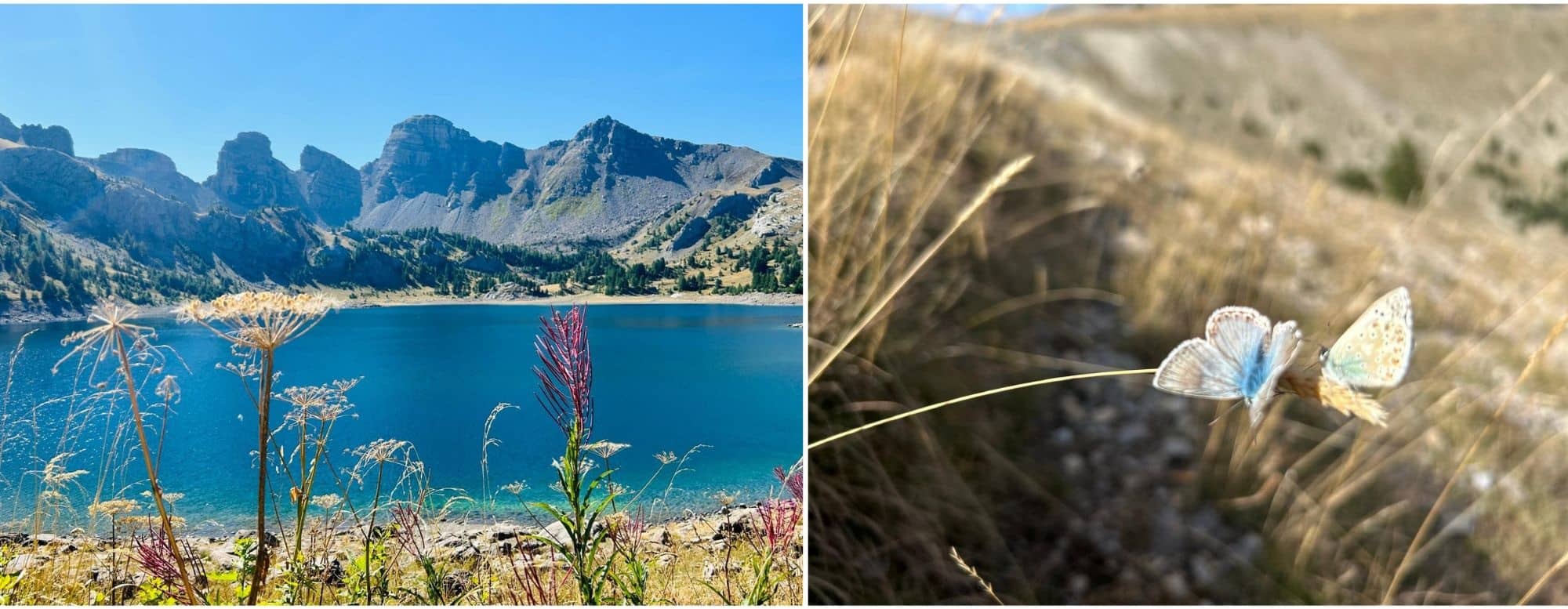 Parc National du Mercantour, France (left); European common blue somewhere near Peyresq, France (right). © Garima Gupta
Another aspect of my work that I deeply value is the opportunity it gives me to travel for conferences, summer schools, and workshops. These experiences allow me not only to exchange ideas and build collaborations, but also to explore diverse landscapes and experience biodiversity in different ecological and cultural contexts.
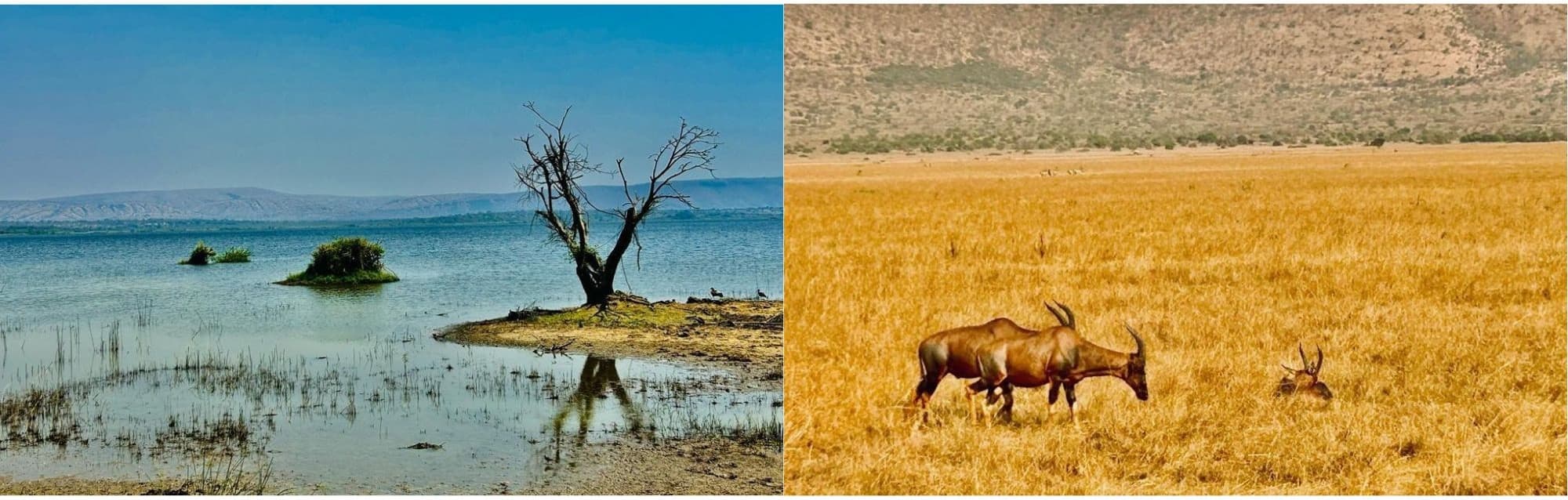 Akagera National Park, Rwanda, Africa (left); Topi antelope in Akagera National Park (right) © Garima Gupta
Together, these elements—the intellectual challenge of research, the chance to contribute to conservation outcomes, and the lived experience of being in the field—make this work deeply rewarding. They continually remind me why conservation must be both scientifically robust and socially just.
Challenges I have faced…
One of the central challenges in my work is navigating the emotional and ethical complexity of conducting conservation research with communities who often bear the costs of both conservation actions and large-scale infrastructure development. As someone deeply invested in social and environmental justice, working closely with people facing displacement, loss of ancestral land, or prolonged uncertainty about their futures can be emotionally demanding. Balancing empathy with analytical distance is an ongoing challenge, particularly when research encounters lived experiences of loss and marginalisation.
A related challenge lies in maintaining the delicate boundary between being a researcher and an activist. While my research is informed by strong values and a clear understanding of the potential ecological and social consequences of certain development pathways, wearing a researcher’s hat requires restraint. Ethical research demands that I do not influence perceptions or decisions, even when I am acutely aware of the risks involved. Navigating this tension—between knowing, caring, and remaining methodologically neutral—is one of the most difficult aspects of my work.
This became especially apparent during my recent research on trade-offs between United Nation’s Sustainable Development Goals in the context of hydropower development in the Greater Himalaya. While interviewing communities to understand their perspectives on large dams proposed in the region, I was often asked for my own opinion or advice. Despite holding strong personal concerns about the impacts of such projects on biodiversity, forests, and ancestral lands, I had to respond with care, ensuring that my presence did not shape or bias their views. These moments underscored the responsibility that comes with conducting research in contested landscapes and highlighted the importance of reflexivity, humility, and ethical integrity in conservation science.
Finally, like many early-career researchers working in interdisciplinary and applied conservation, I face the uncertainty that comes with pursuing long-term, impact-oriented research in systems often structured around short-term projects and outputs. Navigating academic precarity—securing contracts, projects, and sustained research roles—requires persistence and resilience. I have experienced this uncertainty directly, including periods without formal institutional affiliation. During these times, I have remained actively engaged in research by continuing to publish, staying abreast of emerging literature and policy developments, participating in webinars and academic discussions, and consistently applying for positions while developing my own research proposals. These experiences have reinforced the importance of persistence, collaboration, and reflexivity in shaping a meaningful and sustained conservation research career.
My advice to young researchers is…
My honest advice to any young researcher—not just in ornithology—is to focus on persistence and resilience. I often emphasise this when I speak to early-career researchers about navigating careers in conservation, because one of my core beliefs, and personal mantras, is that research is not primarily about intelligence. It is about persistence, resilience, and being genuinely passionate about the questions you are trying to answer and the reasons you are doing the work.
Many Master’s students ask whether they should pursue a PhD simply because it appears to be the obvious next step after a Master’s degree. I usually advise them to undertake a PhD only if they are truly passionate about research, and not because it feels like the next rung on an academic ladder. A PhD requires sustained engagement with the same set of questions for several years, and there will inevitably be periods of uncertainty, repetition, and, at times, difficulty in finding stable roles afterward. Passion for the research itself often becomes the anchor that helps one stay motivated and resilient when the path forward feels uncertain.
Finally, I would encourage young researchers to enjoy the process. Take every opportunity to spend time outdoors—watching birds, observing wildlife, and engaging with landscapes, communities and ecosystems. These experiences not only sustain curiosity and motivation, but also help broaden perspectives and shape meaningful research questions. Staying connected to nature is, in many ways, what keeps the science grounded and the work fulfilling.
Garima Gupta, PhD
[email protected]
Independent Researcher, Former Postdoctoral Research Fellow, University of Stirling
Member of IUCN Galliformes Specialist Group Trustee, Cross River Gorilla Project
LinkedIn
Google Scholar