
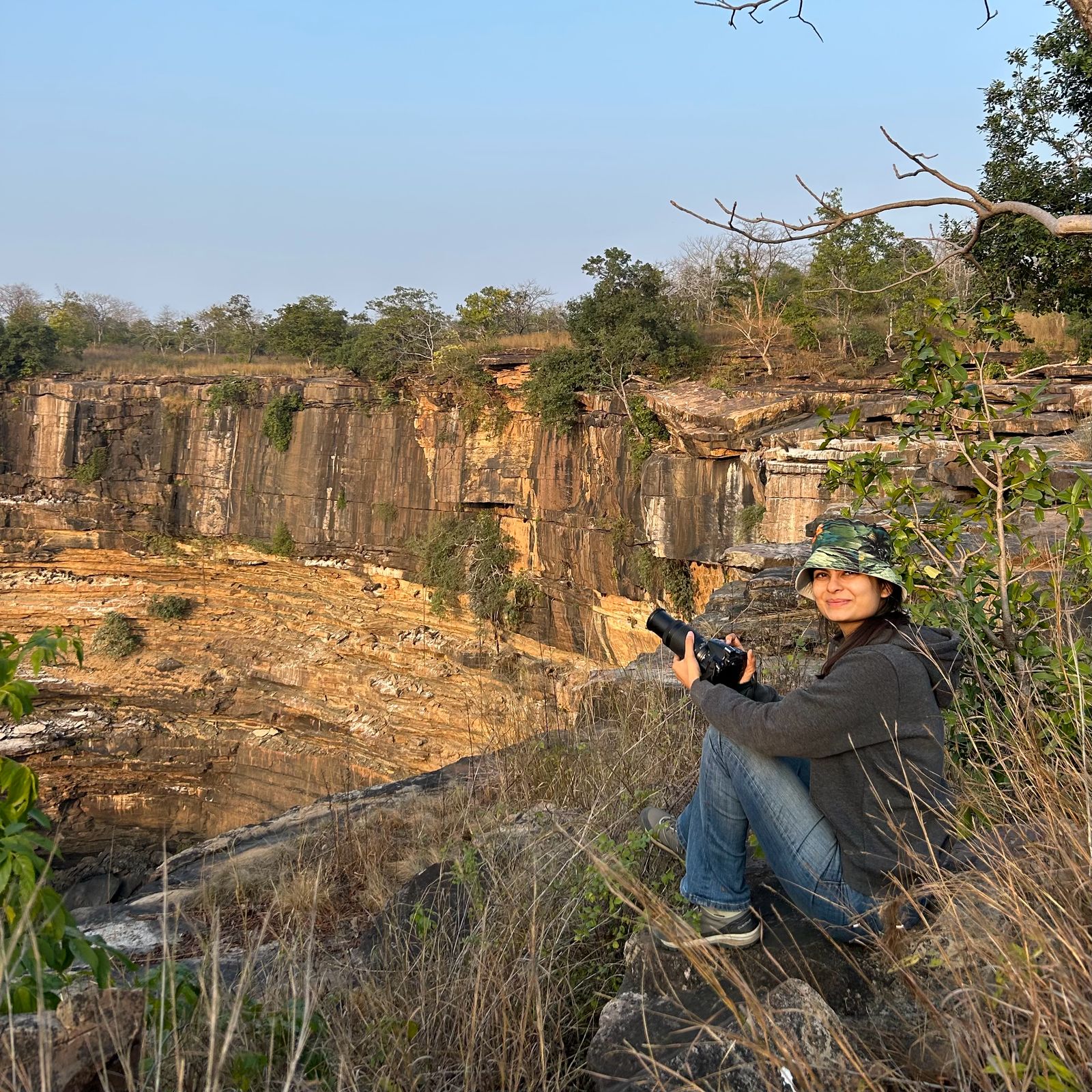
The Shadow Game: How Vultures Found Me
Some of my strongest memories from those years are not just of vultures themselves, but of the people I met because of them.
Curious children on trains who wanted to know what I was working on. Villagers who could identify nesting trees better than any field guide. Livestock owners who had watched generations of vultures return to the same landscape. Forest guards who knew every nesting cliff, every water source, and every hidden trail.
Many were surprised to see a young woman travelling alone through forests with a camera around her neck and binoculars slung across her shoulders. Sometimes they were curious. Sometimes amused. Sometimes concerned. But those conversations became some of the most meaningful parts of my journey.
One memory has stayed with me more than any field observation.
During one of my visits to Nauradehi Wildlife Sanctuary, I explained to a forest guard how White-rumped Vultures often choose the tallest trees in a landscape for nesting. We spoke about how the loss of large nesting trees can force breeding birds to abandon an area altogether.
A few months later, he sent me a photograph. He had planted a Peepal sapling in his village. Not because anyone instructed him to. Not because it was part of a conservation project. Simply because he wanted vultures to have a place to nest in the future. That remains one of my favourite conservation successes.
No report.
No publication.
No grant.
Just a conversation that inspired someone to act.
I think moments like these explain why so many wildlife biologists remain passionate despite the profession’s challenges. The rewards are rarely financial. They come in the form of experiences, connections, and the knowledge that people genuinely care.
This is how my love for birds and nature took shape…
When I tell people that I study vultures, there is usually a pause.
Not the kind of pause that follows hearing about tigers, hornbills, or flamingos. A different pause. Sometimes curiosity. Sometimes confusion. Occasionally, disappointment.
“Why vultures?”
For me, the answer feels obvious now. But it wasn’t always.
Growing up in Bhopal, I was the child who constantly wanted to be outdoors. I was fascinated by animals, forests, and every living thing that seemed to have a story hidden behind it. Like many young naturalists, I started with birds.
While pursuing my Bachelor’s degree in Environmental Sciences at Fergusson College, Pune, I received a Nikon D5300 DSLR from my mother on my eighteenth birthday. She knew how much I loved being outdoors and photographing nature. Suddenly, every bird in the garden became a subject.
I remember being completely captivated by a Purple Sunbird nest on our terrace. How could something so delicate survive wind, rain, and the chaos of the world around it? Questions like these kept me looking closer.
Without realising it, photography taught me my first lesson in field biology: observation.
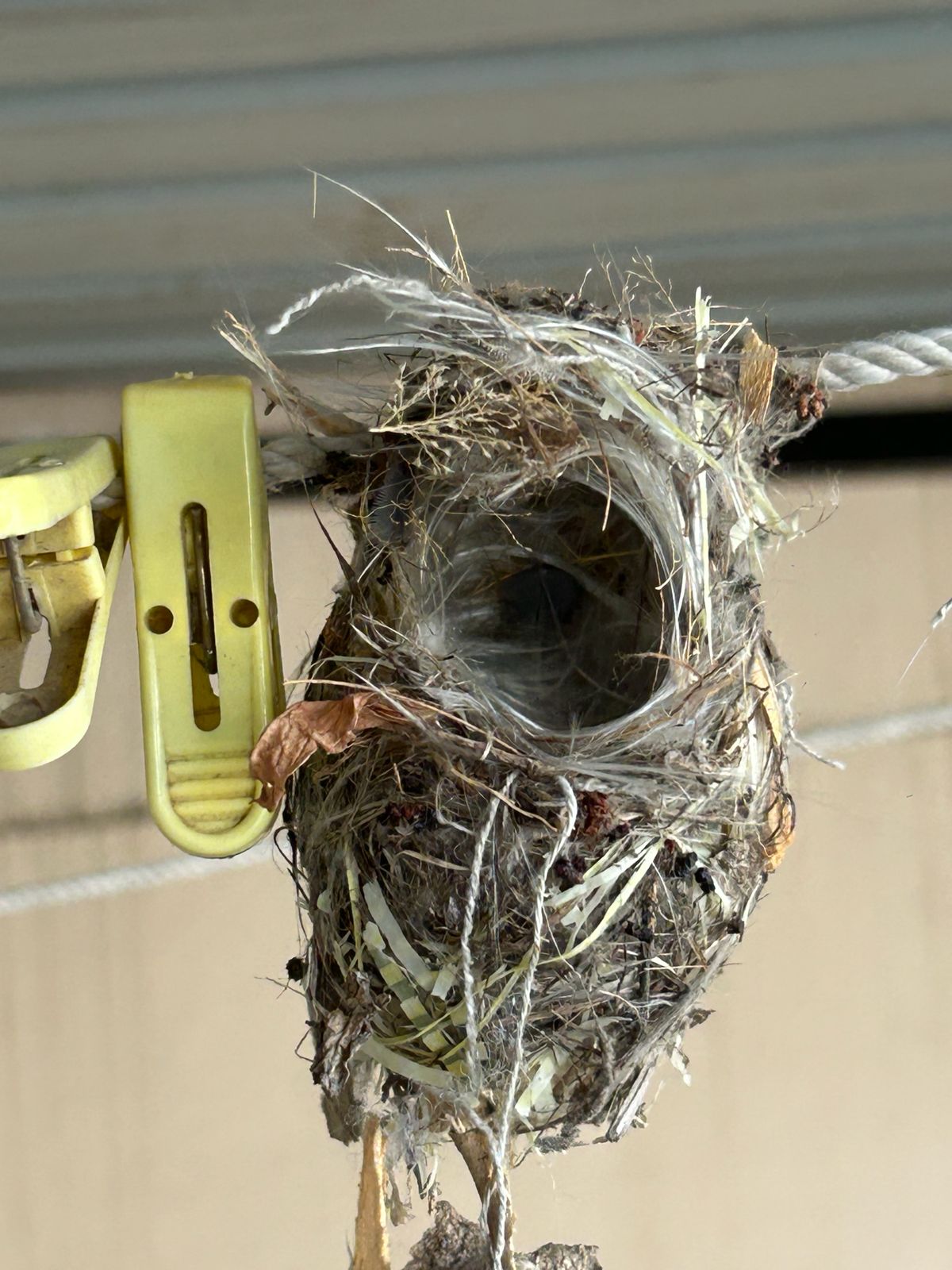 Purple Sunbirds’ nest on my terrace
Years passed, and the birds that stayed with me were not the colourful ones.
They were the ones circling high above the landscape.
The ones most people ignored.
The ones most people misunderstood.
Vultures.
At the time, I did not fully understand how extraordinary they were.
In 2019, I travelled across Himachal Pradesh with my family. During a stop in the village of Kalpa, I was walking with my six-year-old nephew when a giant shadow suddenly engulfed us. Startled, we looked up.
A Himalayan Griffon was soaring directly overhead.
I can still picture that moment—the immense wingspan cutting across the mountain sky, high-altitudinal trees at the back. It was the first time I had seen one, and I stood there completely awestruck.
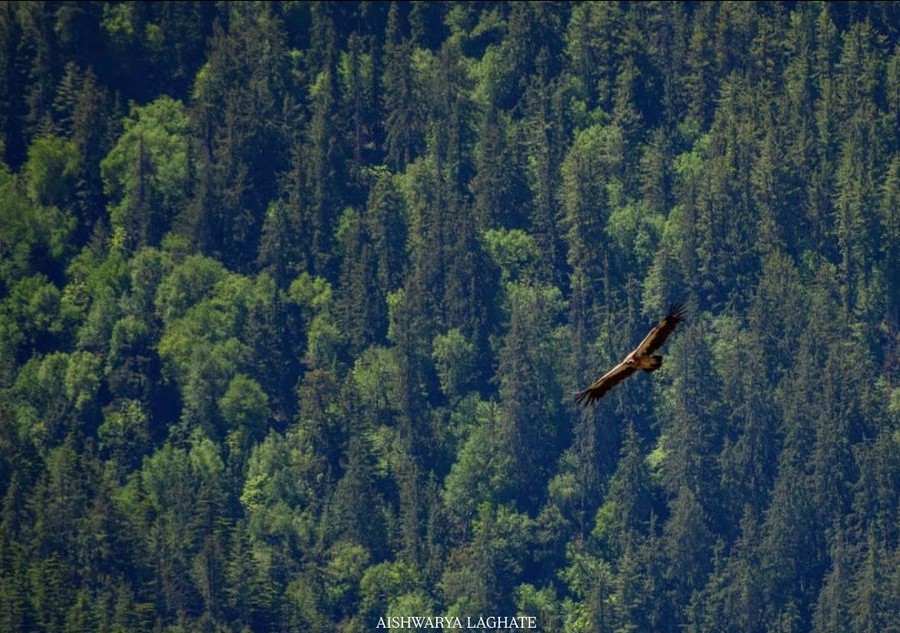 Himalayan Griffon Vulture soaring on thermals in Kalpa, Himachal Pradesh
To understand conservation beyond bird guides and species lists, I later pursued a Master’s degree in Wildlife Conservation and Action at the Bharati Vidyapeeth Institute of Environment Education and Research (BVIEER). I wanted to learn how science could help solve real-world conservation problems.
Around the same time, my team won a wildlife quiz competition in college. Among the prizes was a book titled Vanishing Vultures of India by Ela Foundation.
I learned that India had witnessed one of the fastest bird population declines ever recorded. Species that once numbered in the millions had crashed within just a few decades. Birds that had silently cleaned our landscapes for centuries were disappearing before most people even noticed.
Looking back, I think that encounter from Kalpa stayed with me far longer than I realised. What I did not know then was that vultures would continue finding their way back into my life.
After completing my Master’s, I joined WWF-India’s Raptor Conservation Programme as a Project Officer. For more than three years, I travelled across multiple states in search of raptors.
Some memories remain vivid even today—watching Indian Vultures nesting on cliffs, seeing a White-rumped Vultures’ fledgling practice its first flight, encountering a Spot-bellied Eagle-Owl during surveys in Satpura Tiger Reserve, listening to Brown Hawk-Owls calling from forest meadows after dusk, and locking eyes with a Changeable Hawk-Eagle hidden in the canopy.
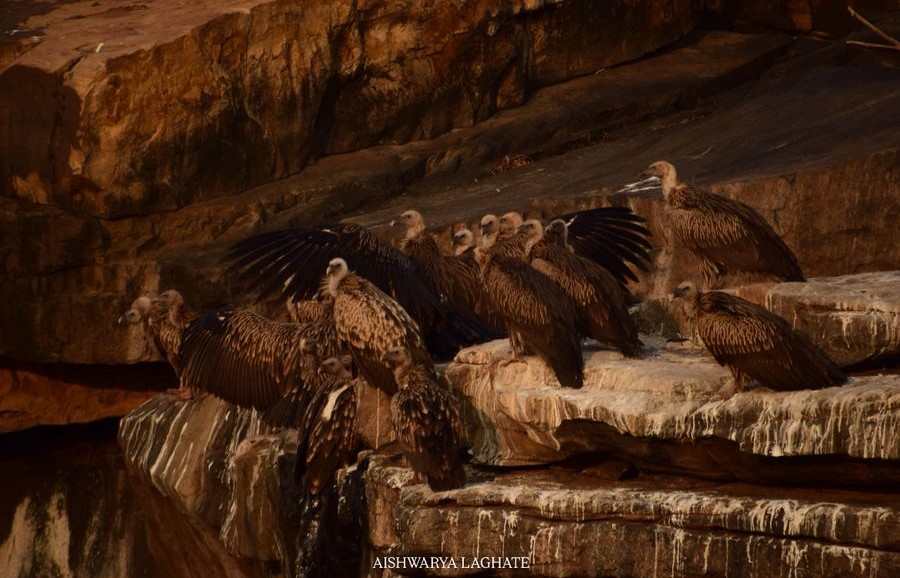 A venue of Himalayan Griffons & Indian Vultures at Panna Tiger Reserve
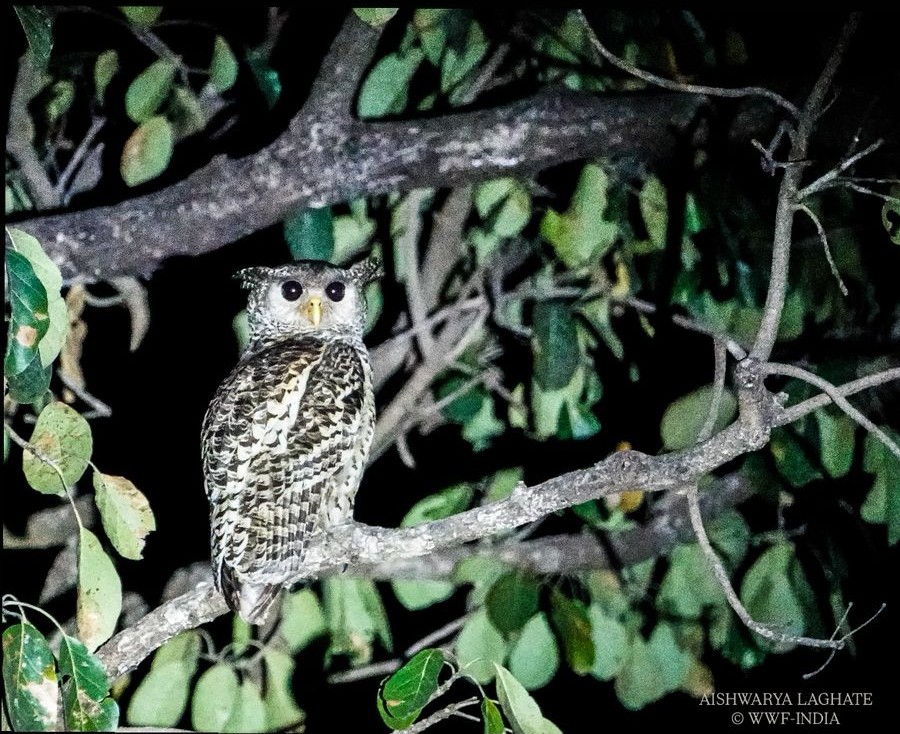 Spot-bellied Eagle-Owl at Satpura Tiger Reserve
I spent countless hours monitoring nests, conducting surveys, engaging with local communities, and sharing stories from the field through photography and outreach.
Those years fundamentally changed how I viewed conservation.
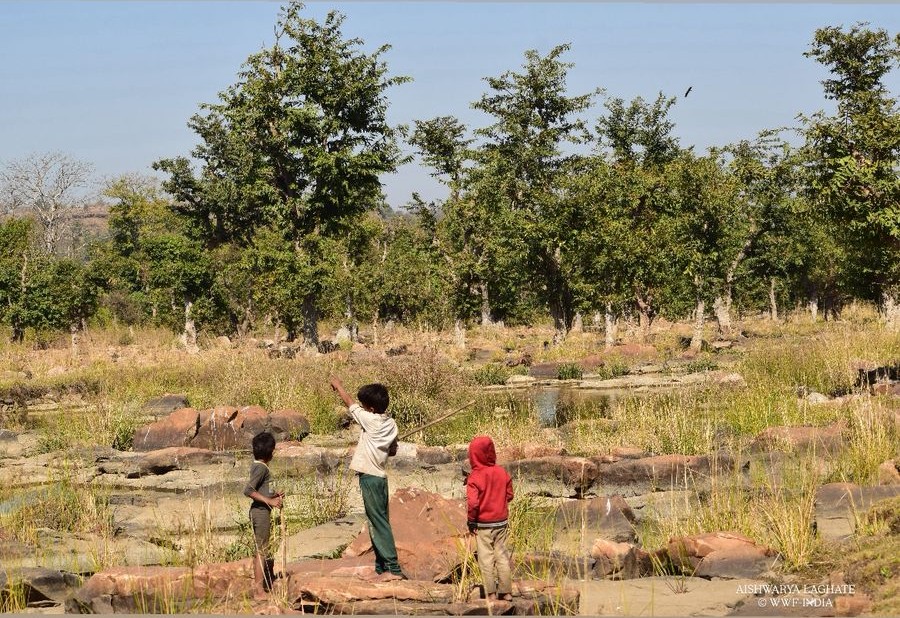 Kids pointing to White-rumped Vulture nests on Arjuna trees
The more time I spent in the field, the more questions emerged. Where do vultures find food in today’s changing landscapes? Why do some areas continue to support populations while others do not? How do different species of vultures interact with one another during feeding events? What makes certain landscapes resilient enough to continue supporting them?
Those questions eventually led me to pursue a PhD.
Today, I am a PhD Fellow at the Centre for Wildlife Studies, affiliated with the Manipal Academy of Higher Education. I started my PhD in 2024 and my research currently is driven by a series of interconnected questions: Where are the carcass dumping sites that vultures rely on, and what makes some sites more attractive than others? How do vulture populations use these sites across seasons? When a carcass appears, which scavengers arrive, how do they interact, and who ultimately gains access to the resource? Finally, are these food sources truly safe, or do they still carry the hidden threat of veterinary drugs such as NSAIDs? By answering these questions, I hope to better understand the role of carcass dumping sites in supporting vulture conservation in central India.
Madhya Pradesh is one of India’s most important strongholds for vultures. Seven of the country’s nine vulture species occur here, and some of the largest remaining populations survive within its forests and human-dominated landscapes.
My work takes me across these landscapes—from protected forests to village carcass dumping grounds, from nesting areas hidden deep within woodlands to sites where hundreds of vultures gather around a single carcass.
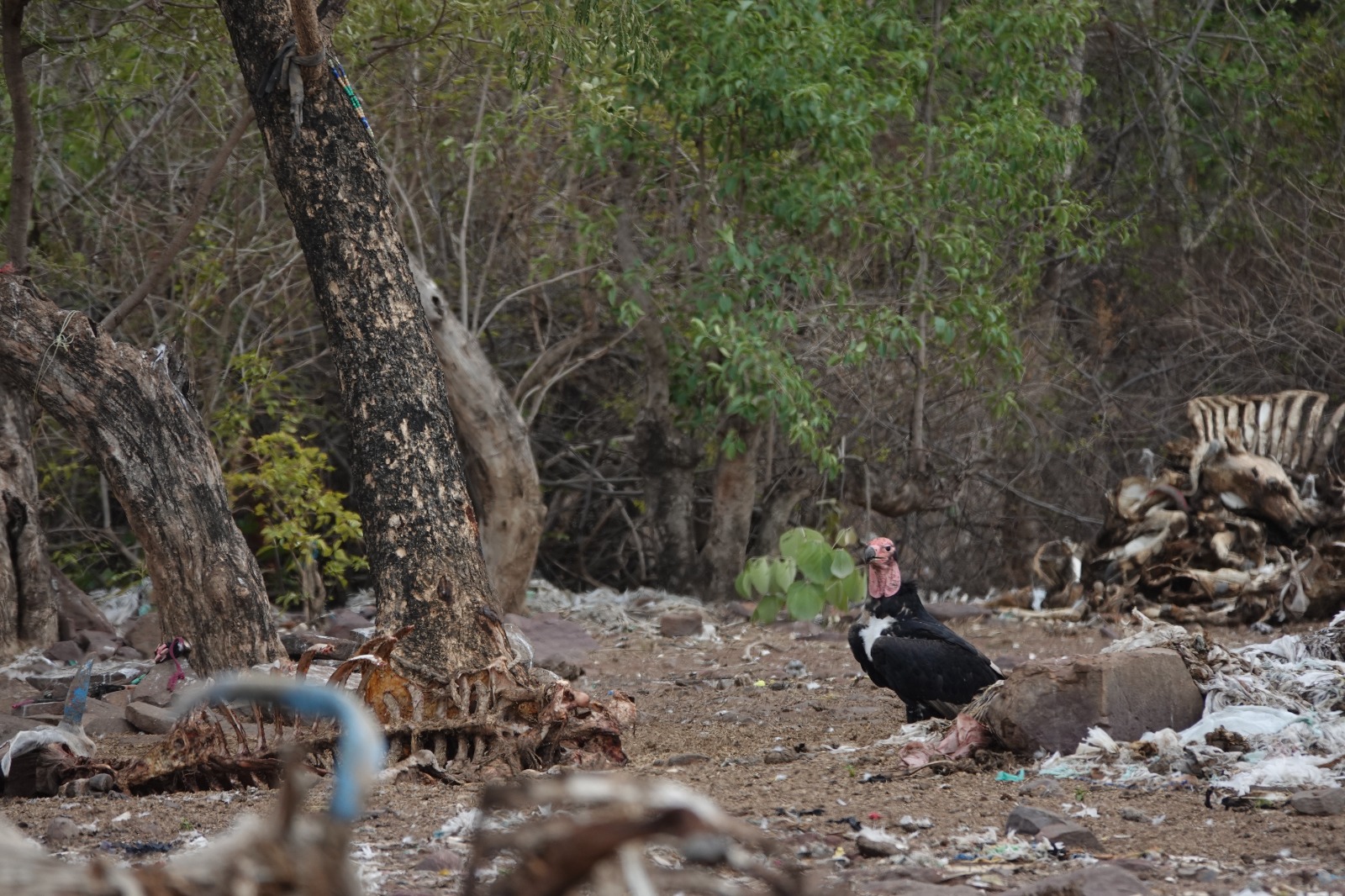 Red-headed Vulture on a carcass dumping site
I love what I do because:
Fieldwork has taught me many lessons. It has taught me patience. It has taught me humility. And it has taught me that wildlife research rarely looks as glamorous as social media makes it seem.
People often tell me, “You have such a beautiful life. You travel, watch birds, and take photographs.”
And yes, there are beautiful moments.
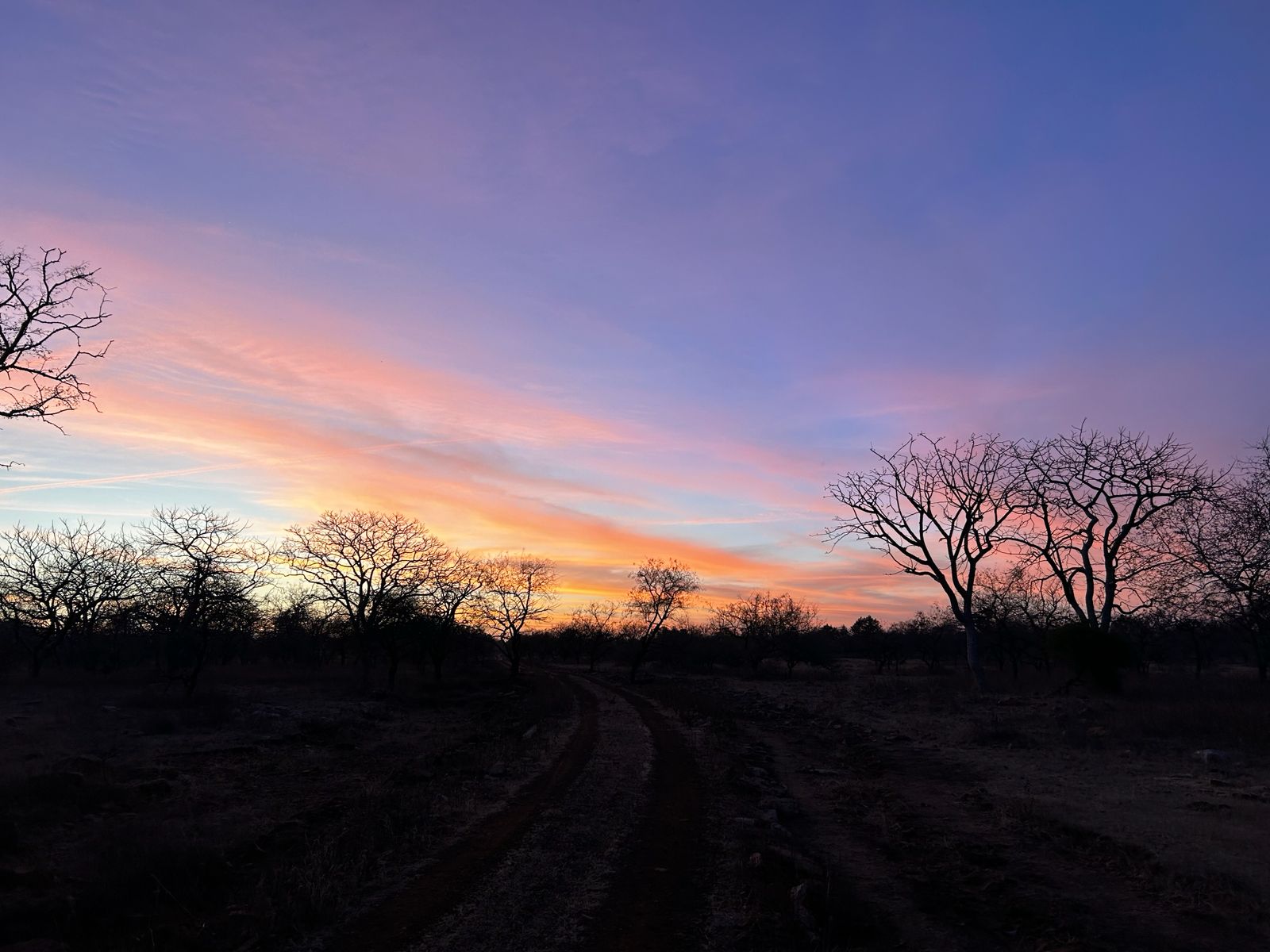 A beautiful sunset at Gandhisagar Wildlife Sanctuary, Madhya Pradesh
Field research is often exhausting, unpredictable, and humbling. Yet those challenges make the rewarding moments even more memorable. Watching dozens of vultures descend from the sky and finish off a carcass in less than thirty minutes. Finding an active nest after hours of searching. Seeing local communities take pride in protecting a species that much of the world overlooks. Those are the moments that stay with you.
One of the most transformative experiences of my journey came in 2025, when I joined Hawk Mountain Sanctuary in Pennsylvania, USA, as a Conservation Science Trainee.
For someone who had spent years working with vultures in India, the opportunity felt almost unreal.
At Hawk Mountain, I worked alongside researchers studying raptors through banding, monitoring, measurements, and field research. I handled species I had only read about before—Eastern Screech Owls, American Kestrels, Cooper’s Hawks, Barn Owls, and Black Vultures. I met researchers, educators, volunteers, and students from different backgrounds, all united by a shared commitment to understanding and conserving birds of prey.
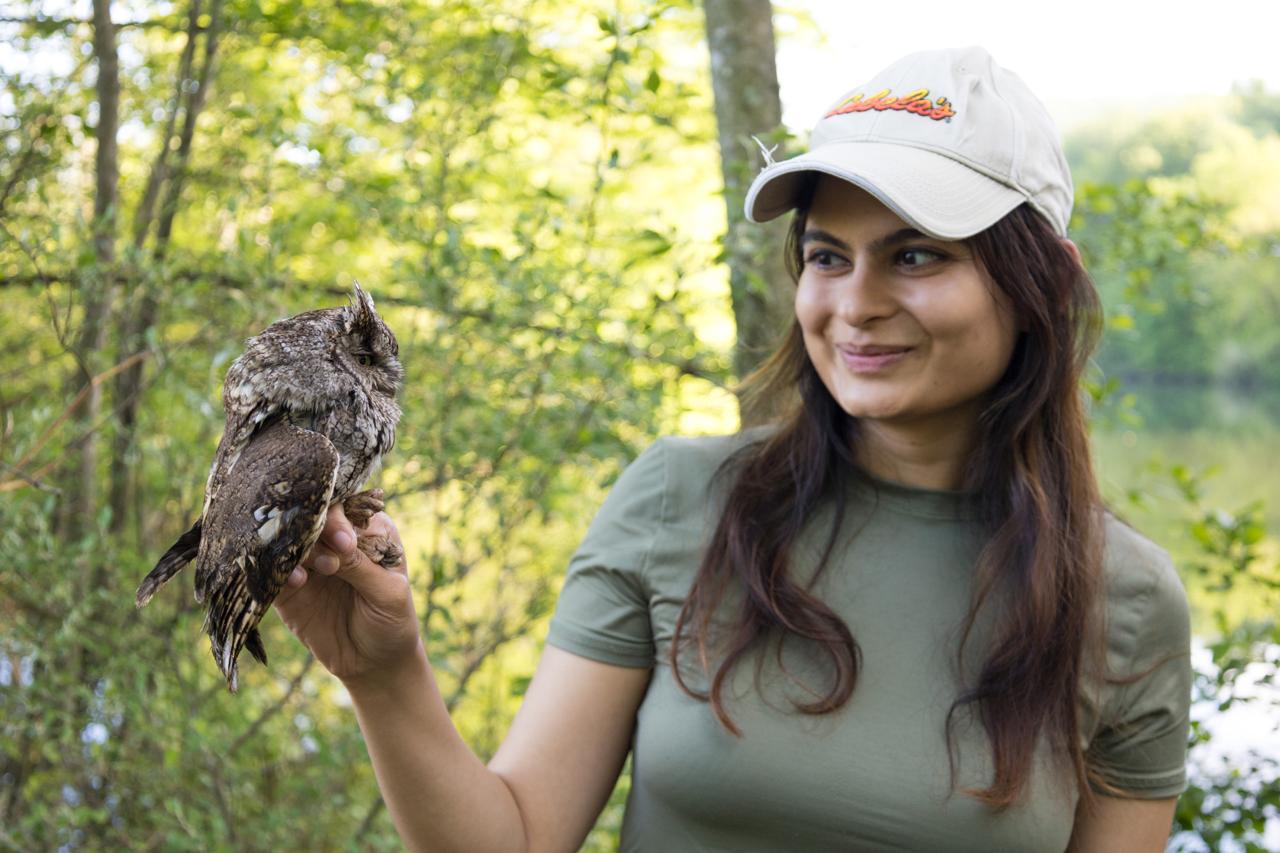 Banding an Eastern Screech Owl, Hawk Mountain Sanctuary, USA
The experience reinforced something I had been learning throughout my journey:
Conservation is both deeply local and profoundly global. The challenges may differ. The species may differ. But the passion remains remarkably similar.
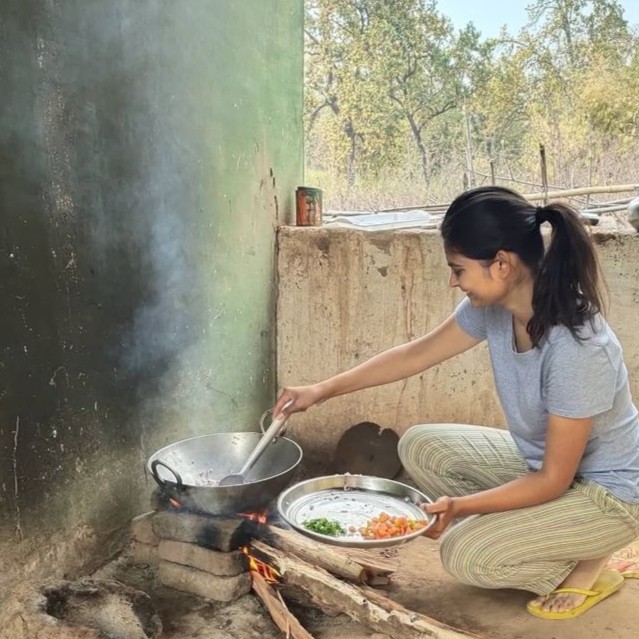 Cooking during fieldwork is a therapeutic experience, Bandhavgarh Tiger Reserve, 2021
People often ask whether I always knew I wanted to work in wildlife.
The answer is yes.
I think I figured it out during a safari in Satpura Tiger Reserve when I was eight years old. I remember looking around and thinking that if there were a job that let someone spend their life around wildlife, that person must be the luckiest in the world.
Years later, I still feel that way.
Challenges I have faced…
One of the biggest lessons wildlife conservation has taught me is that passion alone is not enough. It helps you begin the journey, but persistence is what keeps you going.
Fieldwork often looks exciting from the outside. People see photographs of forests, birds perched on branches, or researchers travelling to beautiful places. What they do not see are the long hours, uncertainty, physical exhaustion, and countless challenges that happen behind the scenes.
Some of those challenges are universal to field research. There are days when field plans collapse because of weather, equipment failures, inaccessible roads, or simply because the species you are studying decides to be somewhere else. There are days spent monitoring nests in temperatures above 45°C, travelling for hours only to return with little data, and weeks of work that do not always go according to plan.
As a woman working in wildlife conservation, there are additional challenges that often go unspoken.
Many of my field seasons have involved travelling alone through remote landscapes, staying in unfamiliar places, and spending long periods in forests far from basic facilities. Even something as simple as managing menstrual hygiene during extended field visits can become a logistical challenge in remote areas. Safety, accommodation, transportation, and even access to basic necessities often require an extra layer of planning.
There have also been moments when I felt the need to constantly prove myself. Whether it was to colleagues, local stakeholders, or forest staff, there were times when people seemed surprised that a young woman could spend weeks in the field carrying equipment, conducting surveys, or navigating difficult terrain. Many of these interactions came from curiosity rather than ill-intent, but they still required resilience and confidence.
Over time, I realised that field biology demands much more than scientific skills – you have to gather the courage, adaptability, and the willingness to step outside your comfort zone repeatedly.
The field of conservation has introduced me to some remarkable women who have paved the way for younger researchers like me. Seeing them lead research projects, conduct fieldwork in difficult conditions, and build successful careers gave me confidence that I belonged here, too.
Their journeys reminded me that representation matters.
Every woman who chooses to work in wildlife conservation makes it a little easier for the next generation to imagine themselves doing the same. If my own journey encourages even one young girl to believe that she can pursue a career in wildlife biology, then I would consider that a meaningful achievement.
My advice to young researchers is..
If I could offer one piece of advice to young researchers interested in ornithology, it would be this: start with curiosity and let it guide you.
Many of us enter this field because of a memorable bird, a childhood fascination, or a moment outdoors that stayed with us. So spend time outside.
Watch birds.
Ask questions.
Take notes.
Learn to observe.
Bird identification is important, but ornithology is much more than knowing names. Pay attention to behaviour, habitats, interactions, and the stories unfolding around you. Some of the best researchers I have met are not necessarily the ones who know the most species, but the ones who never stop asking “why?”
At the same time, remember that passion alone is not enough.
Develop skills.
Learn how to write well. Learn statistics, GIS, scientific communication, and data management. Read papers. Attend workshops. Volunteer whenever you can. We live in a time when information is more accessible than ever before. Make use of it.
One habit that helped me enormously was staying organised. I kept (& still keep) spreadsheets of courses, workshops, scholarships, conferences, grants, and opportunities that interested me. It sounds simple, but careers are often built through consistent efforts rather than dramatic breakthroughs.
Just as importantly, do not compare your journey to anyone else’s.
Wildlife biology can sometimes feel like a race. Social media often makes it seem as though everyone is publishing more papers, winning more grants, or achieving more than you are. In reality, every researcher moves at their own pace.
And for those who are already on this journey and struggling with imposter syndrome: welcome to the club. It is more common than most people admit. Over the years, I have met some brilliant ecologists and conservation biologists who have quietly confessed to carrying the same doubts. Feeling uncertain does not mean you do not belong in this field.
Research itself is built on uncertainty.
Accept that you will make mistakes. Accept that projects will fail. Accept that not every application, manuscript, or proposal will be successful.
Those setbacks are not signs that you should stop.
They are part of the process.
If there is one thing I would advise young researchers not to do, it is this: do not lose the sense of wonder that brought you here in the first place.
It is easy to become consumed by deadlines, publications, funding applications, and career milestones. While those things matter, they should never completely replace the joy of watching a bird do something unexpected or discovering something new about the natural world.
Stay curious. Stay humble. Be kind to people. Be patient with yourself.
And allow yourself to be surprised.
You never know which bird, conversation, or chance encounter might change the course of your life.
Aishwarya Laghate
[email protected]
PhD Fellow, Centre for Wildlife Studies | Manipal Academy of Higher Education
Instagram
Soar high Gyps lagahate!! It’s always encouraging to hear you…