
It was the summer of 2017, and I was high in the Eastern Himalayas, deep inside Khangchendzonga National Park in Sikkim. I had joined an expedition with Dr. Trevor Price from the University of Chicago and his then PhD student, Supriya, mist-netting birds across an elevation gradient. On the way up, I was racking up lifers, my first time in the higher elevations of the Eastern Himalaya, a male Fire-tailed Sunbird in full breeding plumage among them, glinting past us like something out of a dream. Everyone kept telling me these high slopes were pheasant country, especially for the Blood Pheasant and the Himalayan Monal, and I hadn’t seen either.
We reached our highest plot at around 4,300 metres ASL, just past the tree line, in the early afternoon. The land was bare and brown, scattered with juniper. By three or four, it started to drizzle, and I remember being almost charmed by it. Then the drizzle turned into snow. In peak May. I hadn’t expected that at all.
It didn’t stop. We spent the rest of the day setting up mist nets and sampling insects, snow falling the entire time, and by nightfall it still hadn’t let up. We were above the tree line, no structures around for miles, nothing to hide behind if the mountain decided to throw anything else at us, and at one point it did: the odd lightning strike lighting up the sky in the distance, just to keep things interesting. I shared a tent with a teammate, and we took turns through the night pushing snow off the top so we wouldn’t wake up buried. Neither of us slept much.
When I crawled out in the morning, the whole world had changed colour. Everything brown and bare the day before was now completely white. We had a bit of time before heading down, and it hit me that this was my last real chance to see the pheasants. I still hadn’t seen either the monal or the blood pheasant, but the blood pheasant was the one that had lodged itself in my head.
As the morning wore on, mist rolled in, thick and slow. I finished packing early and told the others I’d take one last walk before we left. I followed a faint trail through the junipers, and within minutes the fog had closed in completely. Visibility dropped to under five metres.
Then I heard a rustle, close by. I stopped. For a moment there was nothing but white and the sound of my own breathing, and then a shape began to take form out of the fog. It stepped closer, and I realized what I was looking at: a Blood Pheasant. I froze, a deer in headlights, and just watched. It wasn’t alone. One by one, more emerged until there were six, foraging calmly barely ten metres from where I stood, entirely unbothered by my presence.
That morning, standing in the fog with six blood pheasants going about their business, is still one of the most vivid memories I carry from all my years of fieldwork.
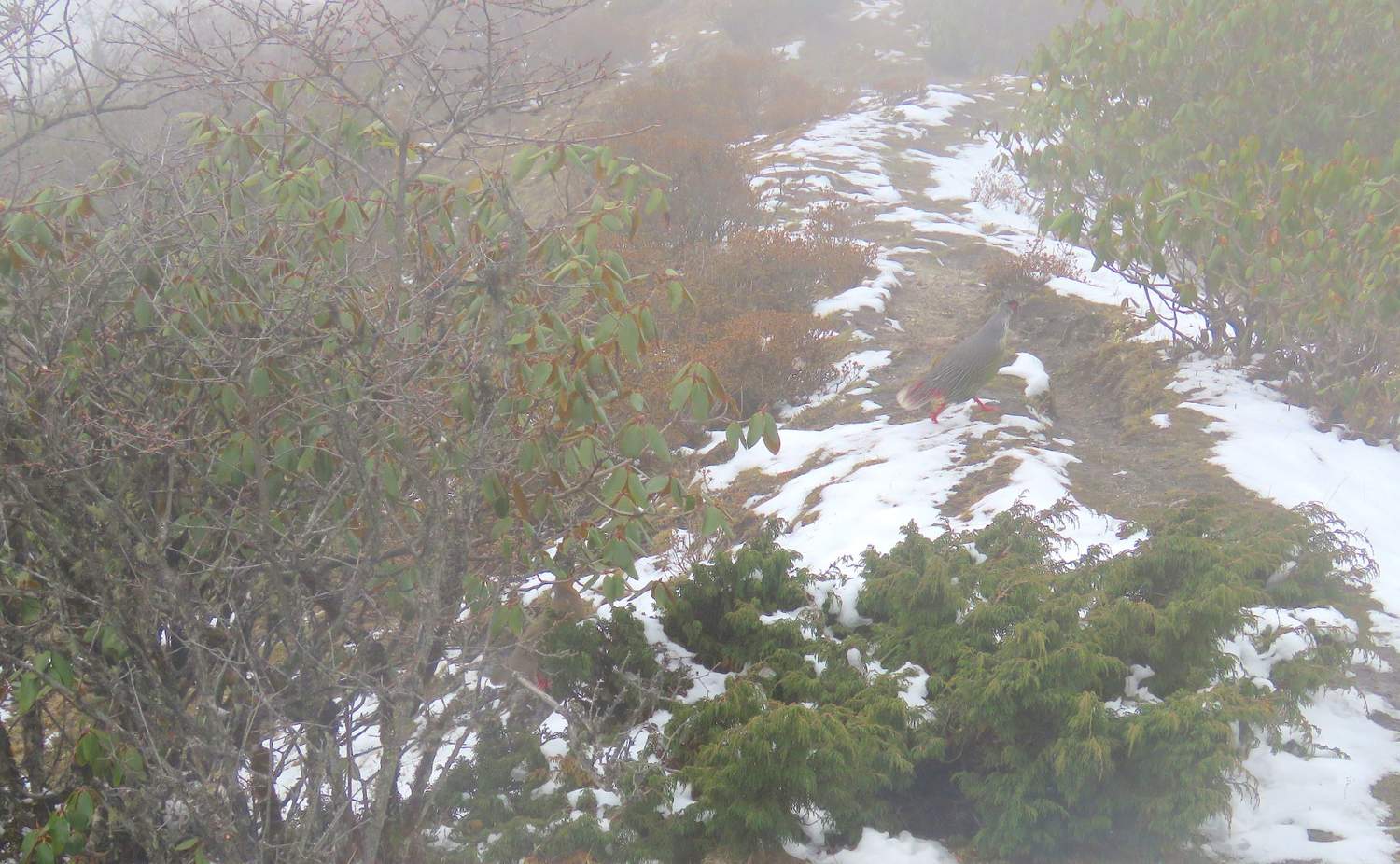
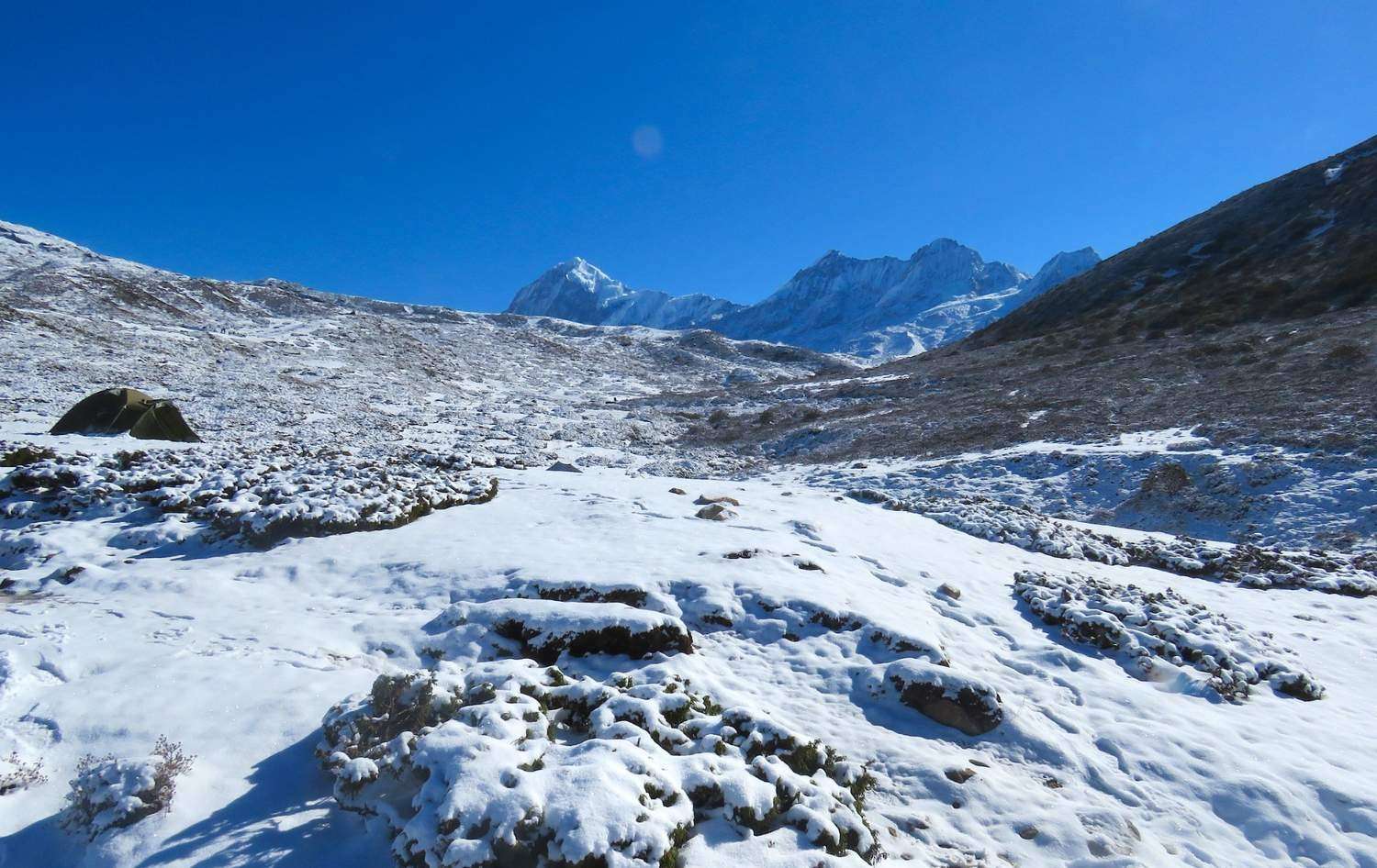 Above: Blood Pheasant in Khangchendzonga National Park, Sikkim; Below: Campsite after an entire night of snowfall
I moved around a bit growing up, mostly through small towns in rural West Bengal and Tripura, before eventually settling in Bangalore, where I spent most of my life growing up. I was always drawn to the outdoors, insects especially, though I had no real idea how to go about pursuing that. At some point I realized I was interested in biology, but I didn’t want to go down the medical sciences route, which was the norm then if you liked biology.
I ended up doing my B.Sc. at Christ University, Bangalore, and that changed everything. It’s where I got introduced to a youth collective called Green Army, spearheaded by Dr. P.U. Antony, who was head of the Zoology department at the time. He pushed us to be outdoors, to actually look at things, and got us interested in bird watching. For the first time, I met a group of people who shared the same interests, over-enthusiastic, ambitious kids who got excited by literally everything. We took frequent trips and treks in and around Karnataka, conducted Great Backyard Bird Counts regularly in our campus, got involved in outreach activities, and even ended up on a lake restoration project that became a bittersweet success none of us quite anticipated. That’s really where it all started.
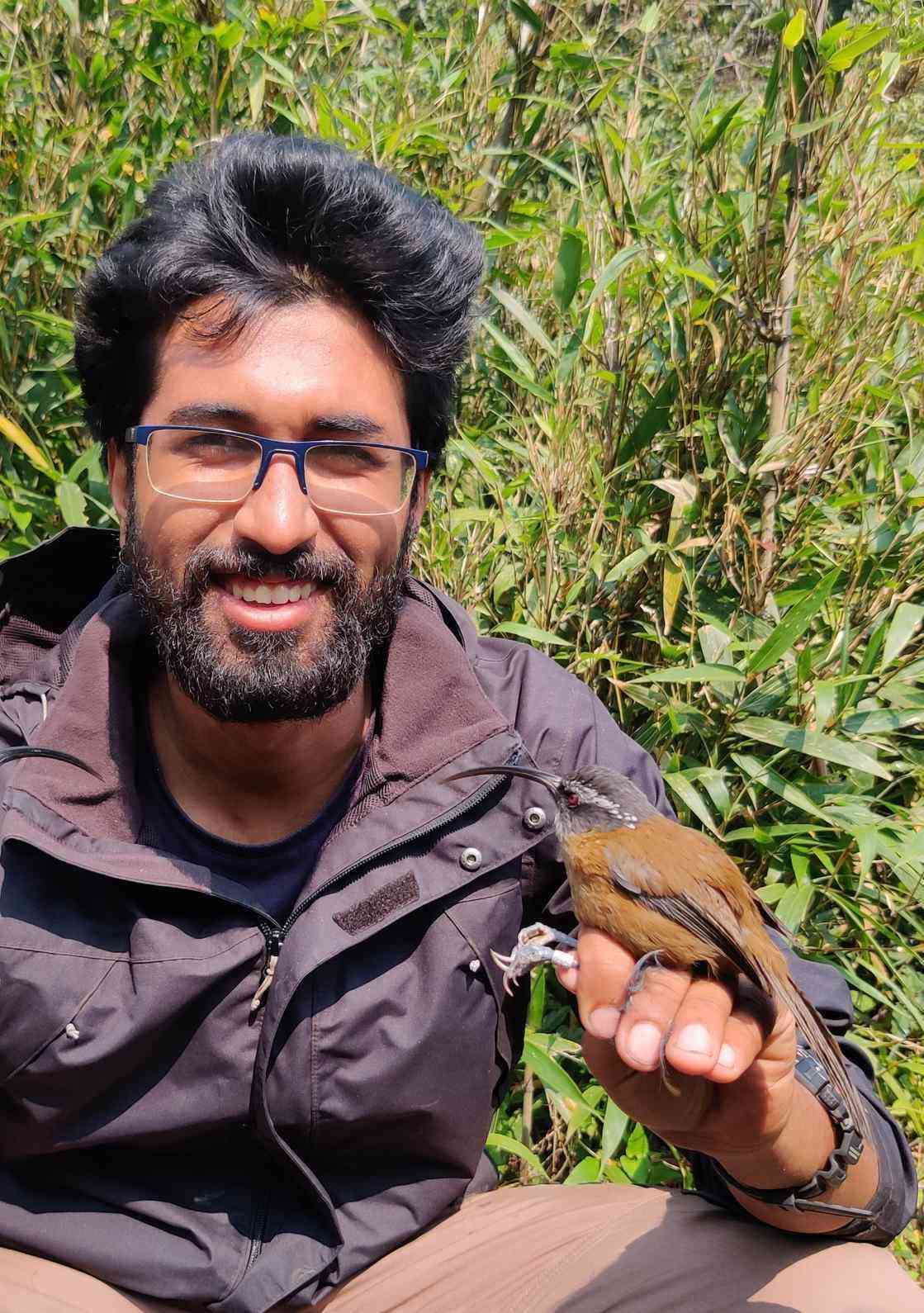
Once I was at Christ, that pull toward wildlife only grew stronger. We had a small group of us interested in wildlife research, not just birds, and we spent most of our holidays volunteering and interning with organisations across India. I ended up on a real mix of projects: assisting with human-snake conflict work and general fieldwork at the Agumbe Rainforest Research Station, studying human-leopard interactions with WCS-India in Himachal Pradesh with Shweta Shivakumar, one of the best bosses I have had the chance to intern with, and mist-netting passerines in the Eastern Himalayas. Somewhere in the middle of all that was the Yellow-wattled Lapwing breeding ecology project at Agumbe, my first real taste of a focused bird study, and it was around then that working with birds specifically started to feel different from the rest.
After my bachelor’s, I took a year off and spent it in Kumaon, in the Western Himalayas, working with Dr. Ghazala Shahabuddin on habitat use and niche partitioning in woodpeckers, across a gradient of forest disturbance in the oak forests there. I was already birdwatching regularly by that point, but that year was when working with birds stopped being just an interest and became something I wanted to actually build a career around.
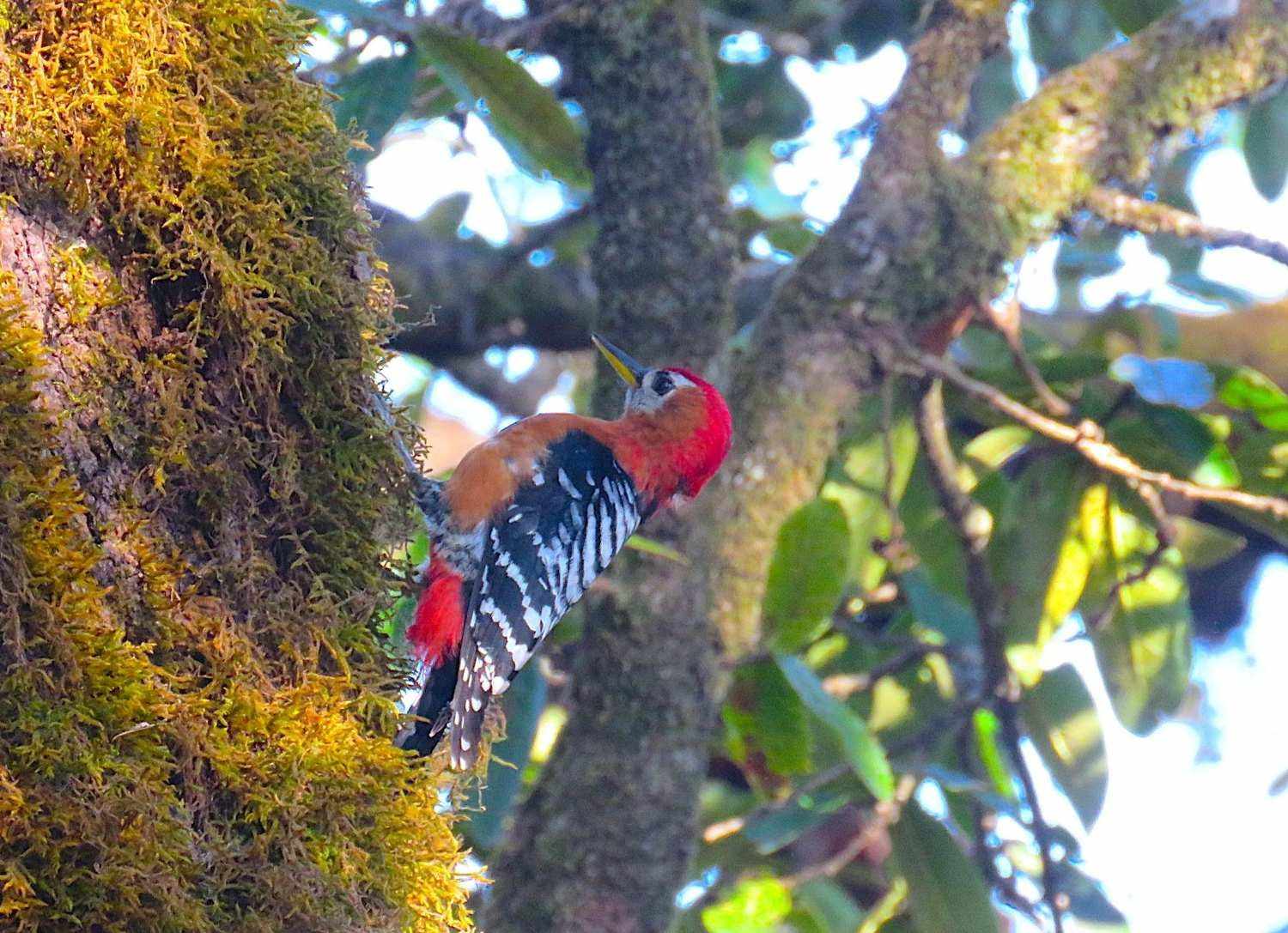 Rufous-bellied woodpecker going about its business in Kumaon, Uttarakhand
I did my MSc at BVIEER, Pune. For my master’s thesis, I worked with Dr. V.V. Robin at IISER Tirupati, looking at how landscape change was affecting endemic birds in the Shola Sky Islands of the southern Western Ghats. After that, I spent around two and a half years with Dr. Umesh Srinivasan’s lab at the Centre for Ecological Sciences, IISc, studying the effects of climate change and selective logging on bird communities in the Eastern Himalayas, a stretch of long-term fieldwork that really shaped the direction I am in now. Both periods were some of the most intense fieldwork I have done, but also the most fun, and I got to work with brilliant mentors along the way.
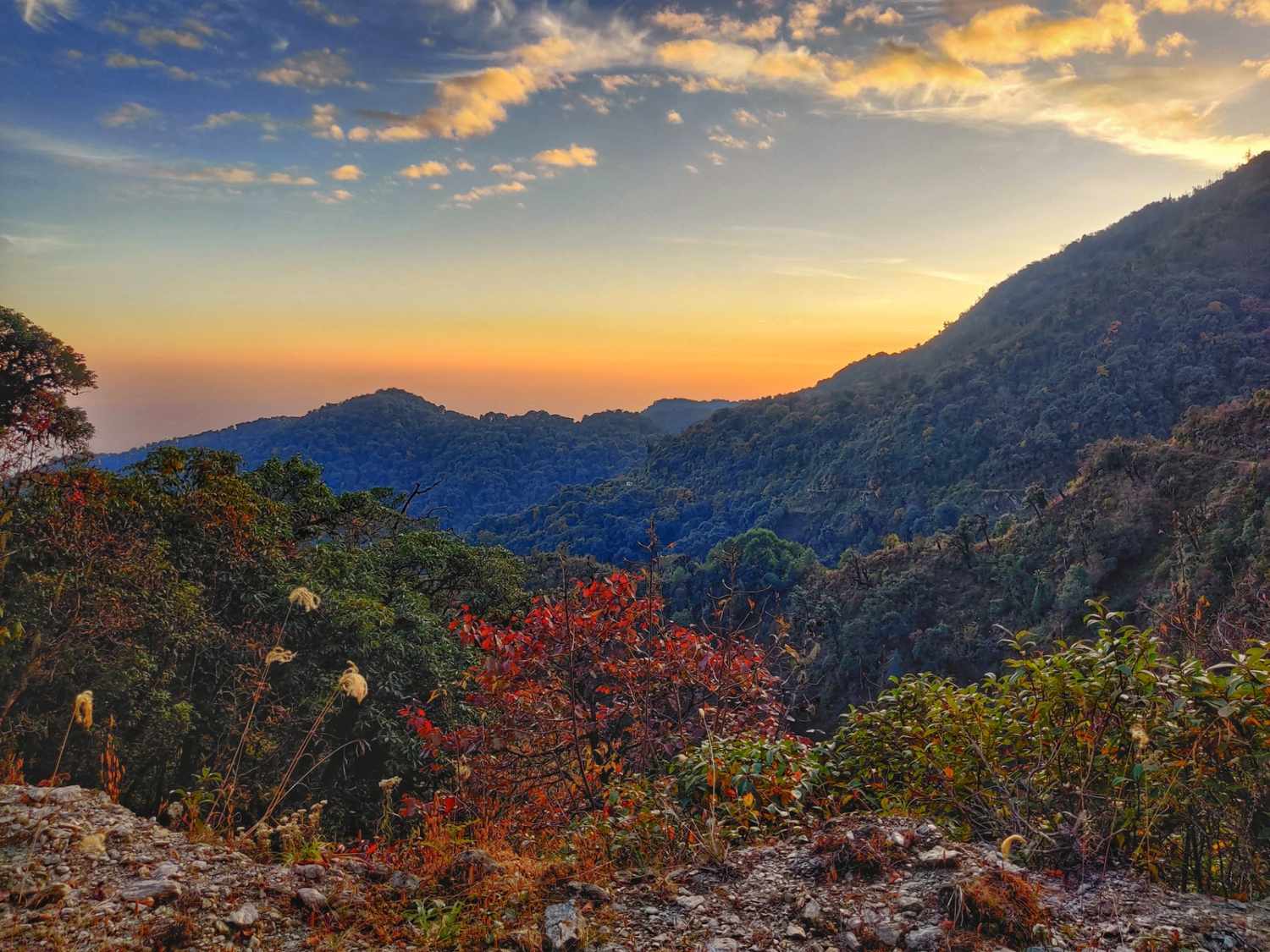
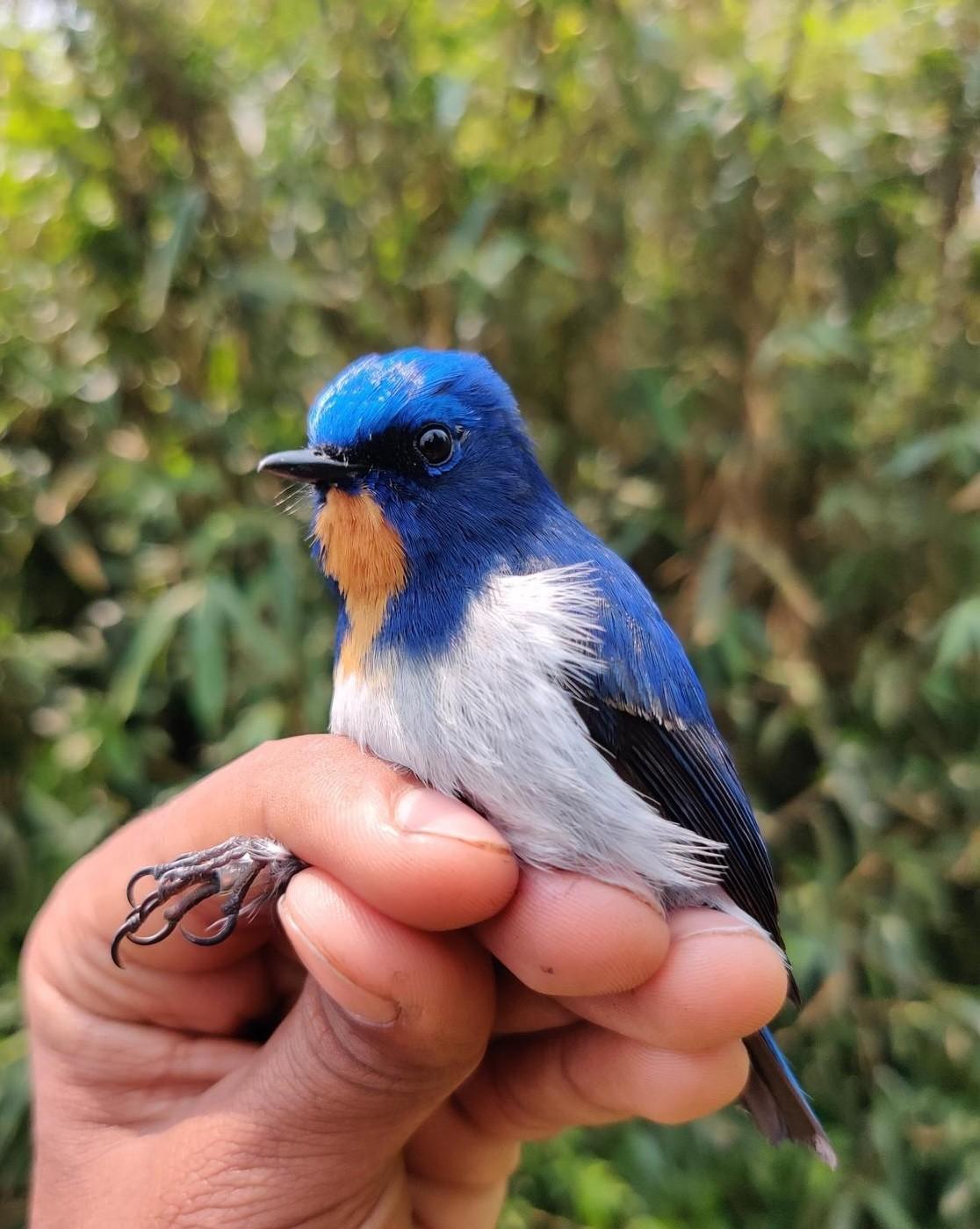 Above: Montane forests of Eaglenest Wildlife sanctuary, Arunachal Pradesh; Below: Banding a Sapphire Flycatcher
I currently work with Dr. Aparajita Datta‘s group at NCF’s Eastern Himalaya Program, based out of Pakke Tiger Reserve in Arunachal Pradesh. Broadly, my work involves analysing long-term data on hornbill breeding, plant phenology, and climate variability, drawing on one of the longest continuous hornbill monitoring programs in the world, over 26 years of nest data across three sympatric species. I look at how temperature and climate variability shape breeding timing, when hornbills enter their nests, how long they stay, and what drives the year-to-year variation we see, and alongside this, whether resource availability, particularly fruit, mediates the relationship between climate and breeding. I am also involved in a few other projects within the group, including one on cavity availability for hole-nesting birds, and broader fieldwork assessing hornbill conservation status across Arunachal Pradesh.
I love what I do because:
What I love most is the sheer variety of it: the travel, the people I meet from completely different parts of the world, the forests and landscapes I would otherwise never set foot in. Most days bring a new experience I am really grateful for. It also feeds a genuine curiosity, trying to figure out what these birds are actually up to, why they do what they do, and that’s a satisfying thing to spend your working life on. There’s real joy in just being out there, watching some piece of behaviour unfold in front of you that you couldn’t have predicted.
One of the best parts, honestly, is something small: holding a bird in your hand while ringing its leg with a band, getting to see it up close like that. It’s a strange kind of connection, and it never really gets old, though I wish I got to do it more often than I do.
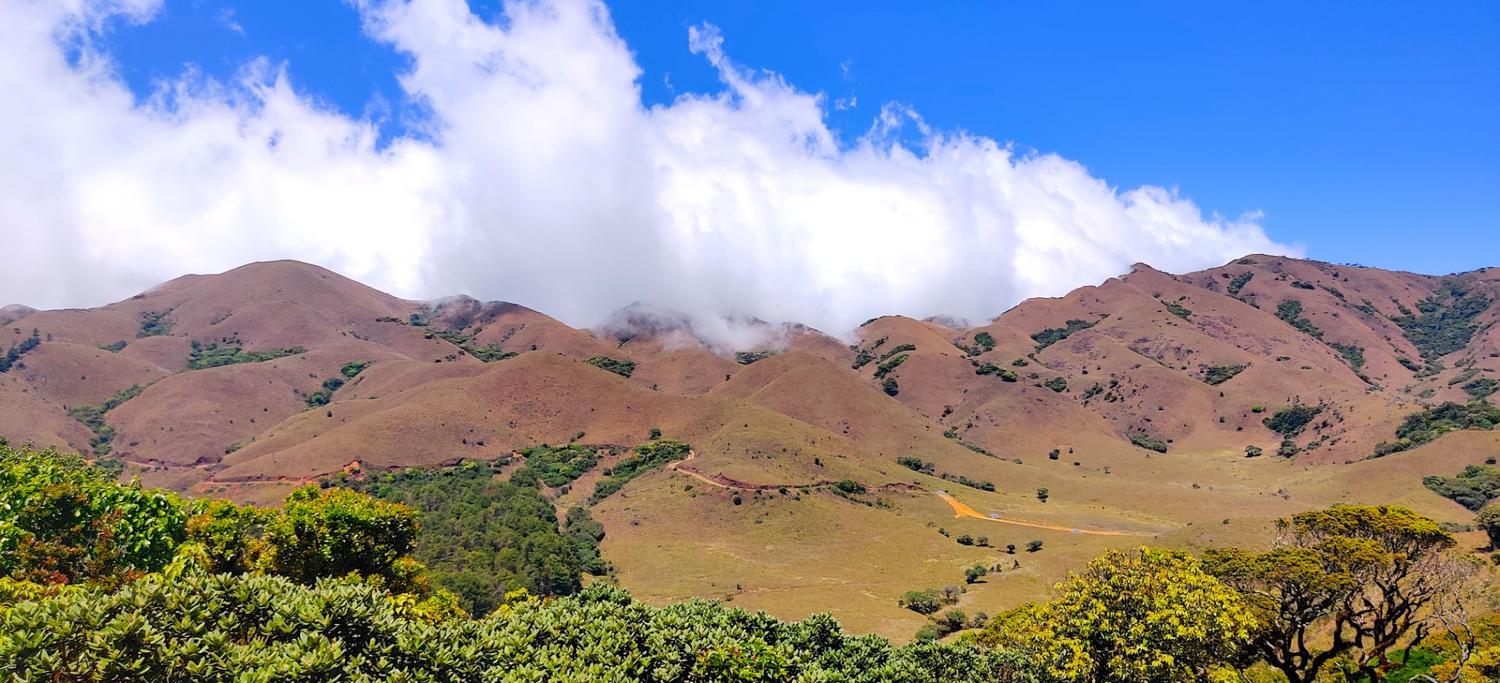 Shola forests and grasslands of Mukurthi National Park, Tamil Nadu
Challenges I have faced..
Honestly, I consider myself to have been really fortunate, and I want to acknowledge that. I have had certain privileges, growing up where I did, and the opportunities that came with the way I was raised, and being a male in this field. Over the past ten, twelve years, I have had the chance to work with some amazing people, field collaborators like Amir da and Micah among them, mentors and peers who’ve shaped how I think about this work and made the harder parts of it easier to get through.
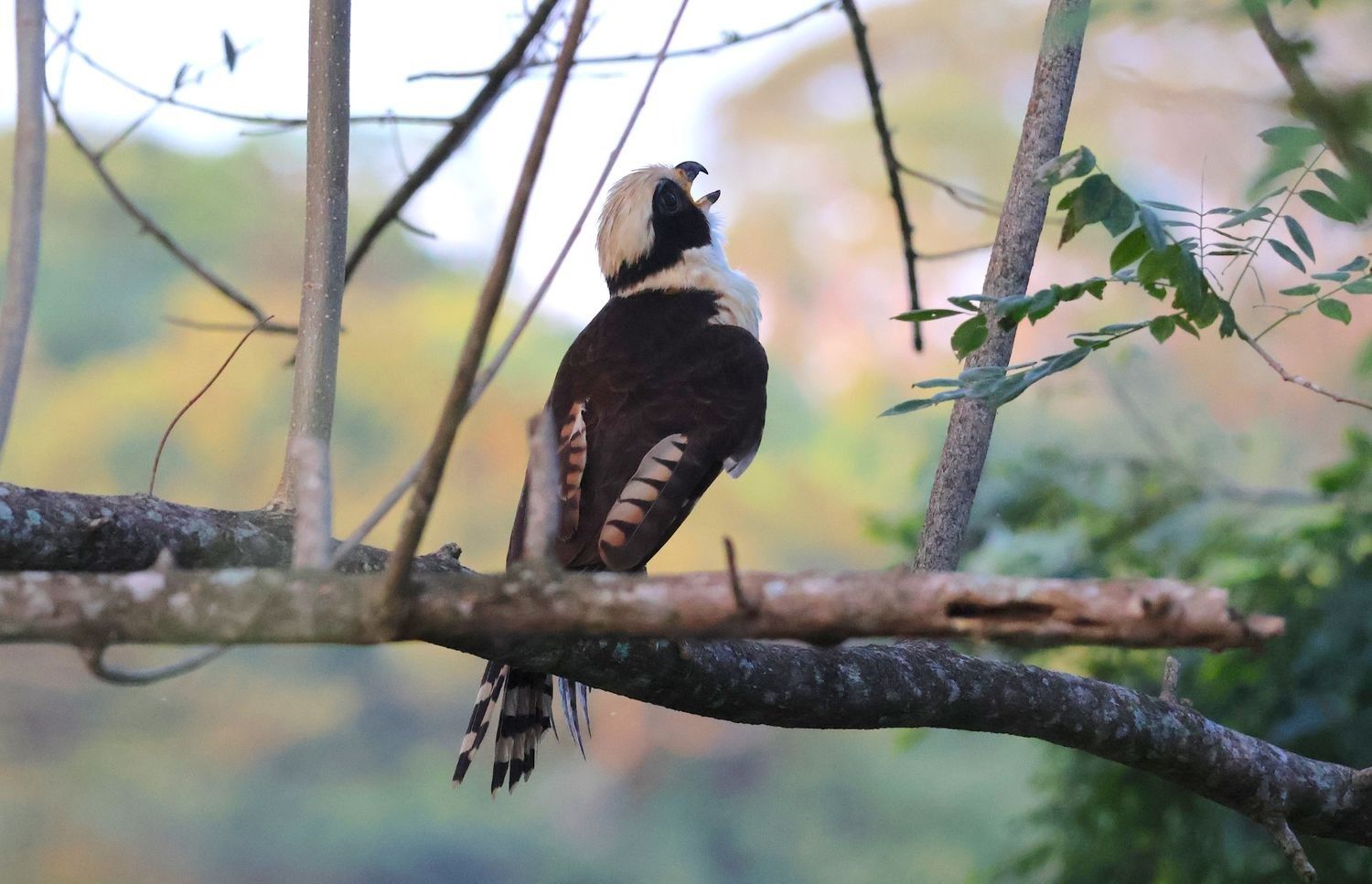 One half of a pair of Laughing Falcons duetting as the sun sets over a transitional forest that marks the shift between the dry forests and the wet forests of central Pacific Costa Rica. The pair continued duetting for over 10-15 minutes without a care, entirely oblivious to our presence barely 5 metres away!
My advice to young researchers is..
Fieldwork can be challenging, and often monotonous. It’s okay to admit that. From the outside, it tends to look purely adventurous, and a lot of the time it is, but there are real challenges too. You are often working in wild, remote landscapes, away from basic comforts, dealing with unpredictable weather, long hours, and the sheer physical grind of repeating the same protocol day after day because that’s what good data actually requires.
Always remember to have fun. I think people forget that far too often, and that’s not okay. Also, remember that no one has the same trajectory. It sounds cliché, but it’s true. You have to be able to build your own path.
Be out in the wild. Technical skills, statistics, all of that can be learned at any point. But natural history is important, and being out there, among the birds, will teach you more than almost anything else can. It’s also a beautiful feeling, watching those tiny creatures go about its business, sometimes doing something completely ridiculous.
And through all of it, stay respectful, of the landscapes you’re working in, and of the people whose land and knowledge you depend on. Fieldwork rarely happens in isolation. You are constantly relying on local communities, field collaborators, and colleagues, and building that trust and respect is as much a part of the work as the data collection itself.
And, always remember to keep your ears, eyes, and nose open!
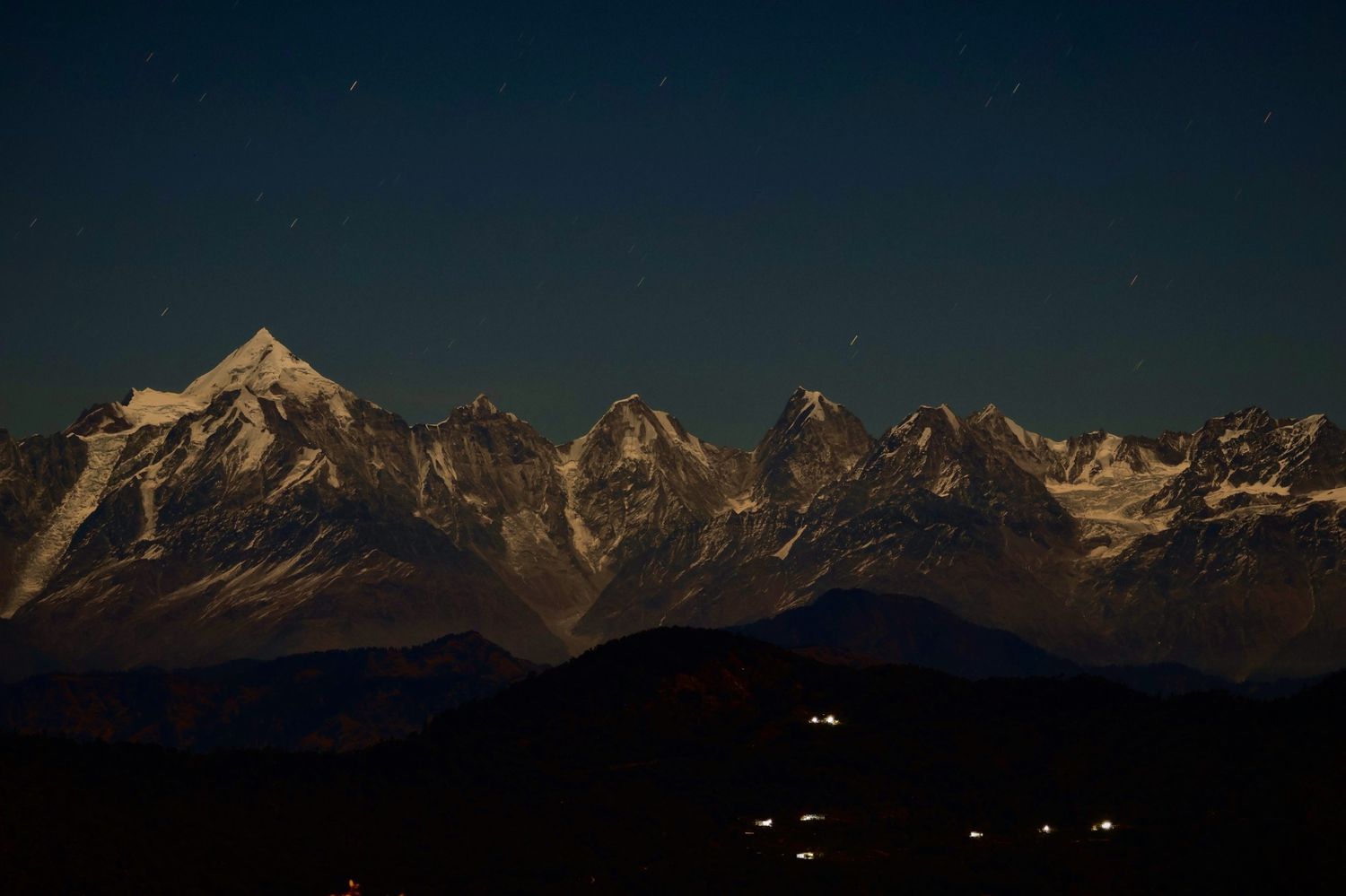 Panchachuli under a full moon night
Ritobroto Chanda
[email protected]/[email protected]
Eastern Himalaya Program, Nature Conservation Foundation
Google Scholar
LinkedIn
ResearchGate
Hi R Chanda,
You took me to different world of dreams for a while.
Your experience is amazing…
I feel your work and research have life.
Keep it up… and thank you for being best example for young people (of course everyone) which is confused what to do.